Retroperitoneal Fibrosis (RPF)
Retroperitoneal fibrosis (RPF) is a rare fibro-inflammatory process that usually surrounds the abdominal aorta and iliac arteries and may encase the ureters, IVC, renal vessels, and adjacent retroperitoneal structures.[1][9] Idiopathic RPF is immune mediated.[2] For the reconstructive urologist, RPF matters because ureteral obstruction occurs in about 60–80% of idiopathic cases and, in one 26-patient RPF referral cohort, 40% had renal function deterioration at diagnosis, making prompt drainage and coordinated medical and surgical management central reconstructive priorities.[3][4][5][6] Referral-series figures vary with case mix (hydronephrosis was present in about half of patients in pooled retrospective series).[5]
The pathway for RPF-related obstruction (medical therapy, drainage for moderate-to-severe obstruction or threatened renal function, and ureterolysis for refractory obstruction) is covered in detail on the Ureterolysis technique page.[1]
Epidemiology
- Estimated incidence 0.1 per 100,000 person-years; prevalence about 1.38 per 100,000.[3]
- Men affected 2–3× more often than women; mean age at presentation 50–60 years.[3][5]
- No clear ethnic predisposition or familial clustering.[3]
Classification and Etiology
RPF is broadly divided into idiopathic (> two-thirds of cases) and secondary forms.[1][6]
Idiopathic RPF
- May be isolated or part of IgG4-related disease (IgG4-RD). IgG4-related RPF shows greater male predominance, higher serum IgG4 or IgE, elevated eosinophils, and multi-organ involvement versus non-IgG4 idiopathic RPF (in one 132-patient cohort, 89% of IgG4-related RPF had other organ involvement, and none of the non-IgG4 group did).[1][7]
- The 2019 ACR/EULAR classification criteria for IgG4-RD require involvement of at least one of 11 characteristic organs (retroperitoneum and aorta are both listed), apply 32 exclusion criteria, then score weighted clinical, serologic, radiologic and pathologic domains; a total of 20 points or more classifies IgG4-RD (specificity 99.2%, sensitivity 85.5% in the first validation cohort).[25] These are classification, not diagnostic, criteria; RPF has no general standardized diagnostic criteria, while the revised Japanese organ-specific criteria for IgG4-related cardiovascular/retroperitoneal disease had 77.2% sensitivity and 94.7% specificity against expert diagnosis in a retrospective 95-patient validation set.[3][25][34]
- Often associated with other autoimmune conditions (Hashimoto thyroiditis, psoriasis) and fibro-inflammatory disorders.[4]
- Multifactorial: genetic susceptibility (notably HLA-DRB1*03), environmental exposures (asbestos, smoking), and immune dysregulation.[4][8]
Major randomized updates
Idiopathic RPF, steroid sparing (2025): a two-center, open-label noninferiority trial randomized 60 adults with eGFR >30 mL/min/1.73 m² to methotrexate plus lower-dose prednisone or standard-dose prednisone. Remission maintained through month 9, defined as symptom resolution, freedom from ureteral obstruction and drainage devices, and normal acute-phase reactants, occurred in 26/29 (89.7%) versus 25/31 (80.6%); difference 9.1 percentage points (95% CI −9.9 to 27.3), meeting the prespecified noninferiority criterion with lower cumulative steroid exposure.[22]
IgG4-related disease (MITIGATE): in 135 adults receiving the same glucocorticoid taper, a treated adjudicated flare occurred in 7/68 (10%) with inebilizumab versus 40/67 (60%) with placebo over 52 weeks (HR 0.13, 95% CI 0.06–0.28); serious adverse events occurred in 18% versus 9%.[23] FDA approved inebilizumab for adult IgG4-RD on April 3, 2025.[24] In the 194-patient phase 3 INDIGO trial of active IgG4-RD, weekly subcutaneous obexelimab reduced flares requiring rescue treatment through 52 weeks versus placebo (26/97 vs 53/97; hazard ratio 0.44) during a glucocorticoid taper.[33] This supports specialist management of confirmed IgG4-related RPF (see the general IgG4-RD treatment review),[15] not automatic use in all idiopathic fibrosis or a claim of ureteral-obstruction cure. Before inebilizumab, screen for hepatitis B and tuberculosis, measure quantitative serum immunoglobulins, and review vaccinations; active HBV infection, active or untreated latent tuberculosis, and a prior life-threatening infusion reaction to UPLIZNA are contraindications.[24] Assess for active infection before each infusion and follow label precautions for infusion reactions; urgent drainage remains a separate decision.[23][24]
Secondary RPF Causes
| Category | Examples |
|---|---|
| Drugs | Ergot derivatives (methysergide, ergotamine), ergot-derived dopamine agonists (pergolide), hydralazine, analgesics; β-blockers have been reported but a causal role remains unproven.[14][30] |
| Malignancies | Desmoplastic reaction to metastases (prostate, breast, colon) or primary tumors (lymphoma, sarcoma, carcinoid) |
| Infections | Local spread from contiguous foci (tuberculosis) |
| Radiotherapy | Fibrosis limited to the radiation field |
| Histiocytosis | Erdheim–Chester disease (perirenal “hairy kidney” pattern)[1] |
| Other | Prior surgery, pancreatitis |
Pathophysiology
The immunopathogenesis involves complex B- and T-lymphocyte crosstalk, macrophage and fibrocyte chemotaxis, and eosinophil or mast cell recruitment.[1] Mediators include chemokines (CXCL12, CCL11) and cytokines (IL-6, IL-12, IL-13) that simultaneously orchestrate inflammation and promote fibrosis.[4] The disease was historically thought to result from a local autoimmune reaction to antigens within atherosclerotic aortic plaques, but the systemic features and autoimmune associations suggest a broader immune-mediated process.[3]
Clinical Presentation
- Abdominal pain and low back pain are the most common symptoms (65% and 42% in one 26-patient referral cohort).[5]
- Systemic symptoms. Fatigue, weight loss, malaise.[6]
- Less common: constipation, testicular pain, lower-extremity claudication.[6]
- Ureteral obstruction in about 60–80% of idiopathic RPF cases, often causing acute or chronic kidney injury.[6][4]
- Other complications: caval occlusion, deep vein thrombosis, renal artery or vein stenosis, renal atrophy.[1][2]
- Elevated acute-phase reactants (ESR, CRP) in about 75% and renal function deterioration in about 40% at diagnosis in that same cohort.[5]
- Presentation pattern. RPF often begins insidiously with slowly progressive renal dysfunction, but ureteral obstruction can also cause acute colic-like pain and acute kidney injury, particularly when bilateral; severe obstruction may cause oliguria or anuria.[1][3]
Diagnosis
There are no standardized diagnostic criteria. Diagnosis combines clinical, laboratory, and imaging findings.[3]
Laboratory
- Elevated ESR and CRP (supportive but nonspecific).
- Serum IgG4 can support assessment for IgG4-related disease when elevated, but a normal value does not exclude IgG4-related RPF.[1][7]
- Renal function assessment (creatinine, eGFR), urinalysis, and urine protein quantification. In suspected IgG4-related RPF, consider concurrent parenchymal kidney disease when impairment is disproportionate to obstruction or persists after drainage.[31]
Imaging
- CT. Used to diagnose 24/26 patients (92%) in one referral cohort; CT and MRI are the imaging modalities of choice.[5][9] RPF typically appears as a homogeneous soft-tissue plaque, isodense with muscle, surrounding the infrarenal aorta and iliac arteries, often enveloping the ureters and IVC. Contrast enhancement is variable depending on disease stage.[5][9][3]
- MRI. Avoids iodinated CT contrast and offers soft-tissue characterization; contrast-enhanced MRI uses a gadolinium agent, so protocol selection still considers kidney function.[3]
- FDG-PET/CT. Used to assess disease extent, metabolic activity, treatment response, and suspected relapse.[1] In a 50-patient imaging cohort, baseline metabolic active volume was associated with PET-defined metabolic progression in 8 of 30 evaluable patients at later follow-up; that endpoint did not measure clinical relapse or obstruction.[10] In a separate 115-patient treated cohort, persistent end-of-treatment PET activity was associated with subsequent relapse.[11]
- Imaging distinction. Idiopathic RPF classically does not displace the aorta anteriorly and causes medial ureteral deviation, whereas malignant infiltration tends to displace the aorta anteriorly and ureters laterally.[3] This is a tendency, not a rule: in a 92-patient referral series, 18 of 47 patients with a peri-aortic mass and final diagnosis of RPF still had anterior aortic displacement, and 2 of 6 malignant masses did not. A characteristic non-displacing peri-aortic mass supports a benign diagnosis and can spare biopsy; atypical morphology or location does not.[12]
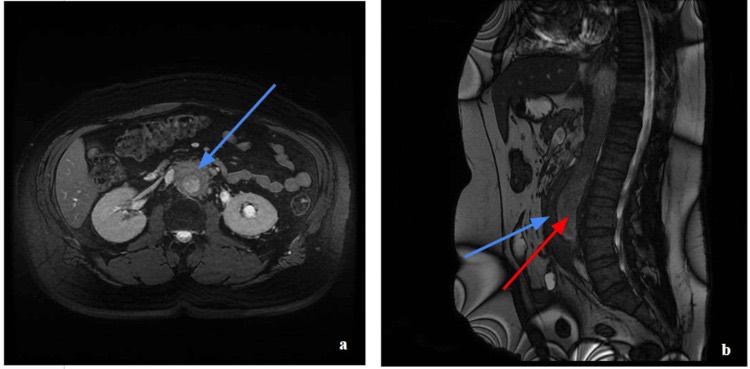
IgG4-related retroperitoneal fibrosis on abdominal MRI. (a) Axial and (b) sagittal images show confluent retroperitoneal soft-tissue thickening surrounding the abdominal aorta and ureters (blue arrows); a fusiform aneurysm of the distal abdominal aorta is also present (red arrow). From Jarai MZ, et al. Cureus. 2026;18(4):e107379, Figure 5 (CC BY 4.0).[29]
Biopsy
Consider retroperitoneal biopsy for atypical imaging, suspected malignancy, inconclusive clinical or laboratory findings, or suspected IgG4-related RPF when no accessible extraretroperitoneal biopsy site is available.[3][13][14] CT-guided needle biopsy is the less invasive option; laparoscopic or open biopsy can provide more tissue when needle sampling is inadequate, particularly if lymphoma is suspected.[14] Assess other IgG4-RD organ involvement and exclude secondary causes (drugs, malignancy, infection, radiation) before labeling RPF idiopathic.[14] Histology shows abundant fibrosis with mononuclear inflammatory infiltrate (lymphocytes, plasma cells, macrophages).[6]
Treatment
Treatment aims to relieve ureteral obstruction and induce disease regression. For idiopathic or IgG4-related RPF, immunosuppression treats inflammation while drainage or ureterolysis relieves mechanical obstruction; secondary RPF management addresses the underlying cause when treatable.[1][13][14]
Surgical Drainage and Ureterolysis
Surgical pathway covered in full on the Ureterolysis technique page. Briefly:
- Ureteral stenting or PCN promptly decompresses moderate-to-severe obstruction, acute kidney injury, or threatened renal function; infected obstruction requires emergency drainage.[1][14][17][32] Mild hydronephrosis with stable renal function may permit medical treatment with close renal and imaging follow-up.[4] In a retrospective series of 30 patients with 44 obstructed urinary units, initial stenting succeeded in 25 of 32 attempted units. Complication rates were 17.9% with stents and 21% with nephrostomy (P = 0.79); the authors considered the drainage methods complementary because some patients needed both over time.[17] The cumulative incidence of acute pyelonephritis during drainage follow-up was 30%.[17]
- Surgical ureterolysis (open, laparoscopic, or robotic, usually with omental wrapping) is generally considered for refractory obstruction, nephrostomy dependence, stent failure, or severe stent symptoms.[13][14][27] In a retrospective obstructive-RPF cohort, medication intolerance, absent radiographic response, and persistent pain were also reported reasons for surgery.[16] Ureterolysis relieves ureteral obstruction but does not treat systemic RPF.[1] In a prospective 50-patient open ureterolysis series managed by a high-volume multidisciplinary team at one specialist center, 47/50 (94%) were stent-free at 12 months; 11/50 (22%) underwent additional intraoperative procedures, including contralateral nephrectomy in 7/50.[27] At 1 year, median GFR changed by +25% in the stent-failure group and −10% in the nephrostomy-dependent group (the latter not significant); Clavien III–IV complications occurred in 12%.[27] The authors argue for considering ureterolysis early when obstruction does not respond quickly to standard treatment.[27]
- In a 52-patient retrospective cohort, medical treatment with temporary renal drainage as needed resolved obstruction without ureterolysis in 36/52 (69%); median stent duration was 16 months, with median clinical and imaging follow-up of 4.2 and 3.3 years. Ureterolysis was later performed in 8/52 (15%), and 9 patients (18%) had recurrent obstruction after a stent-free period.[16]
Medical Therapy
- Glucocorticoids remain first-line for idiopathic RPF, inducing rapid symptom remission, reduction in acute-phase reactants, and often mass shrinkage.[4][14] Typical induction: prednisone 0.5–1 mg/kg/day with gradual taper over 6–9 months.[6][4][11] In the Parma protocol, induction was prednisone 1 mg/kg/day for 1 month, then 0.5 mg/kg/day tapered over 8 months.[6] Higher steroid dose at 1 year and longer courses were associated with fewer relapses in retrospective cohorts.[20][21]
- Prednisone versus tamoxifen. The 2011 trial randomized 36 responders after prednisone induction; continued tapering prednisone prevented relapse better than switching to tamoxifen (relapse by month 8: 1/18 [6%] versus 7/18 [39%]; estimated 26-month cumulative relapse 17% versus 50%), at the cost of more Cushingoid features and hypercholesterolemia.[6]
- Combination therapy: Across 11 mostly observational studies (224 patients), heterogeneous pooled response estimates were 98.9% versus 85.1% (P = 0.08), without evidence that every immunosuppressant combination is superior.[18] Commonly used agents:
- Mycophenolate mofetil. In a prospective 28-patient case series (prednisone 40 mg/day tapered over 6 months plus MMF 1000 mg twice daily for a mean 24 months), systemic symptoms resolved in all, 89% had ≥ 25% mass reduction, and disease recurred in 2 (7%).[26] Uncontrolled.
- Methotrexate and azathioprine are steroid-sparing agents.[4] The 2025 methotrexate trial provides randomized steroid-sparing evidence specifically for idiopathic RPF.[22]
- Tocilizumab. An open pilot enrolling 12 patients with active chronic periaortitis reported that 10/11 evaluable patients (91%) met the partial or complete remission endpoint after 3 months of tocilizumab monotherapy; this is preliminary evidence from a broader periaortitis population.[28]
- Cyclophosphamide. Reserved for severe or refractory disease because of toxicity; not first line.[4]
- Rituximab (anti-CD20 B-cell depletion) is increasingly used for refractory or relapsing disease. In a retrospective series (n = 26; 19 IgG4-related, 7 idiopathic), all 19 with pain improved symptomatically, and 22/25 patients with follow-up imaging (88%) had radiologic improvement; 73% received rituximab without additional glucocorticoids. Severe infections in 12%. Of 10 patients with stents or nephrostomies, 4 became tube-free.[19]
Secondary RPF
- Drug-induced. Withdrawal of the offending agent often leads to resolution; steroids may still be needed.[3]
- Infection-related. Antimicrobial therapy; steroids generally contraindicated.[3]
- Malignancy-related. Chemotherapy or radiotherapy directed at the underlying neoplasm.[3]
Monitoring and Follow-Up
Serial assessment includes symptoms, ESR/CRP, renal function, and imaging.[3] Relapse can occur without symptoms or an acute-phase-reactant rise.[1] At stent or PCN exchange, retrograde or antegrade pyelography can confirm ureteral patency before removal; renal ultrasound after removal checks for recurrent hydronephrosis.[4][14] CT and MRI track mass size; FDG-PET helps assess metabolic activity and relapse risk.[10][11] A nonavid residual mass may represent inactive fibrosis, but the decision to reduce or stop treatment also requires clinical and renal assessment, and surveillance must continue.[1][3] Positive FDG-PET at end of treatment independently predicts relapse (HR 3.47).[11]
Prognosis and Relapse
In a retrospective 50-patient idiopathic RPF cohort followed for a median 8.9 years, patient survival was 95% at 5 years, 84% at 10 years, and 68% at 15 years.[20] However, relapse is a major challenge:
- A review of idiopathic RPF reports relapse in about 10–50% after treatment interruption.[4] In a retrospective 50-patient cohort followed a median 8.9 years, 19/50 (38%) had at least one relapse.[20] In a separate 155-patient cohort followed a median 45.3 months, 27/153 (17.6%) evaluable patients had at least one relapse.[21]
- Cumulative relapse incidence: 21% at 5 years, 41% at 10 years, 48% at 15 years.[20]
Predictors of relapse: male sex, antinuclear-antibody positivity, lower steroid dose at 1 year, higher baseline ESR, shorter glucocorticoid courses, thoracic vessel involvement, and persistent FDG-PET activity after treatment.[20][11][21] Smoking and atypical (for example pelvic) localization predicted lower likelihood of remission rather than relapse; pre-treatment FDG-PET activity predicted remission.[11] In one large cohort, 42% relapsed over a median of 33 months.[11]
Prompt relief of hydronephrosis is needed to prevent irreversible renal atrophy. The reconstructive surgeon's central responsibility in the multidisciplinary RPF team.[21]
See Also
- Ureterolysis: surgical management including stenting or PCN, open or laparoscopic or robotic ureterolysis, omental wrap, decision framework, and inflammatory AAA repair
- Ureteral Stricture: RPF is listed among the inflammatory or infiltrative etiologies
- Upper Tract Reconstruction overview
- C-Reactive Protein: surveillance marker
References
1. Vaglio A, Peyronel F, Bajema IM, Pegoraro F. "Retroperitoneal Fibrosis." Lancet. 2026. doi:10.1016/S0140-6736(26)00037-1
2. Vaglio A, Maritati F. "Idiopathic Retroperitoneal Fibrosis." Journal of the American Society of Nephrology. 2016;27(7):1880–1889. doi:10.1681/ASN.2015101110
3. Vaglio A, Salvarani C, Buzio C. "Retroperitoneal Fibrosis." Lancet. 2006;367(9506):241–251. doi:10.1016/S0140-6736(06)68035-5
4. Raglianti V, Rossi GM, Vaglio A. "Idiopathic Retroperitoneal Fibrosis: An Update for Nephrologists." Nephrology, Dialysis, Transplantation. 2021;36(10):1773–1781. doi:10.1093/ndt/gfaa083
5. Loricera J, Secada-Gómez C, Martín-Gutiérrez A, Blanco R, González-Vela C. "Clinical Features, Diagnosis, and Management of Retroperitoneal Fibrosis in a University Referral Hospital and Literature Review." Internal and Emergency Medicine. 2026. doi:10.1007/s11739-026-04298-x
6. Vaglio A, Palmisano A, Alberici F, et al. "Prednisone Versus Tamoxifen in Patients With Idiopathic Retroperitoneal Fibrosis: An Open-Label Randomised Controlled Trial." Lancet. 2011;378(9788):338–346. doi:10.1016/S0140-6736(11)60934-3
7. Wang K, Wang Z, Zeng Q, et al. "Clinical Characteristics of IgG4-related Retroperitoneal Fibrosis Versus Idiopathic Retroperitoneal Fibrosis." PLoS One. 2021;16(2):e0245601. doi:10.1371/journal.pone.0245601
8. Uibu T, Oksa P, Auvinen A, et al. "Asbestos Exposure as a Risk Factor for Retroperitoneal Fibrosis." Lancet. 2004;363(9419):1422–1426. doi:10.1016/S0140-6736(04)16100-X
9. Caiafa RO, Vinuesa AS, Izquierdo RS, et al. "Retroperitoneal Fibrosis: Role of Imaging in Diagnosis and Follow-Up." RadioGraphics. 2013;33(2):535–552. doi:10.1148/rg.332125085
10. Bayerl C, Kaufmann J, Metzger G, et al. "[18F]FDG PET/CT for Treatment Monitoring and Prediction of Progression in Retroperitoneal Fibrosis." European Journal of Nuclear Medicine and Molecular Imaging. 2025. doi:10.1007/s00259-025-07479-6
11. Bond M, Bettiol A, Buttini EA, et al. "Predictors of Remission and Relapse in Retroperitoneal Fibrosis." Journal of Internal Medicine. 2025. doi:10.1111/joim.70017
12. Cohan RH, Shampain KL, Francis IR, et al. "Imaging Appearance of Fibrosing Diseases of the Retroperitoneum: Can a Definitive Diagnosis Be Made?" Abdominal Radiology. 2018;43(5):1204–1214. doi:10.1007/s00261-017-1282-5
13. Fenaroli P, Maritati F, Vaglio A. "Into Clinical Practice: Diagnosis and Therapy of Retroperitoneal Fibrosis." Current Rheumatology Reports. 2021;23(3):18. doi:10.1007/s11926-020-00966-9
14. Tanaka T, Masumori N. "Current Approach to Diagnosis and Management of Retroperitoneal Fibrosis." International Journal of Urology. 2020;27(5):387–394. doi:10.1111/iju.14218
15. Zhang W, Stone JH. "Management of IgG4-related Disease." The Lancet Rheumatology. 2019;1(1):e55–e65. doi:10.1016/S2665-9913(19)30017-7
16. Santiago J, Swartz R, Marder W, et al. "Including Medical Management in the Urologic Approach to Idiopathic Retroperitoneal Fibrosis." Urology. 2021;152:167–172. doi:10.1016/j.urology.2021.03.002
17. Mertens S, Zeegers AG, Wertheimer PA, Hendriksz TR, van Bommel EF. "Efficacy and Complications of Urinary Drainage Procedures in Idiopathic Retroperitoneal Fibrosis Complicated by Extrinsic Ureteral Obstruction." International Journal of Urology. 2014;21(3):283–288. doi:10.1111/iju.12234
18. Zheng T, Wu Z, Ding Y, et al. "Glucocorticoid Monotherapy vs. Immunosuppressant-Combined Therapy in Retroperitoneal Fibrosis: Clinical Evidence and Mechanistic Insights From Bioinformatics." European Journal of Medical Research. 2026. doi:10.1186/s40001-026-03856-5
19. Wallwork R, Wallace Z, Perugino C, Sharma A, Stone JH. "Rituximab for Idiopathic and IgG4-related Retroperitoneal Fibrosis." Medicine. 2018;97(42):e12631. doi:10.1097/MD.0000000000012631
20. Raffiotta F, da Silva Escoli R, Quaglini S, et al. "Idiopathic Retroperitoneal Fibrosis: Long-Term Risk and Predictors of Relapse." American Journal of Kidney Diseases. 2019;74(6):742–750. doi:10.1053/j.ajkd.2019.04.020
21. Zhao J, Li J, Zhang Z. "Long-Term Outcomes and Predictors of a Large Cohort of Idiopathic Retroperitoneal Fibrosis Patients: A Retrospective Study." Scandinavian Journal of Rheumatology. 2019;48(3):239–245. doi:10.1080/03009742.2018.1497700
22. Peyronel F, Palmisano A, Maritati F, et al. Methotrexate and low-dose prednisone in idiopathic retroperitoneal fibrosis: a randomised clinical trial. J Autoimmun. 2025;157:103487. doi:10.1016/j.jaut.2025.103487.
23. Stone JH, Khosroshahi A, Zhang W, et al. Inebilizumab for Treatment of IgG4-Related Disease. N Engl J Med. 2025;392:1168–1177. doi:10.1056/NEJMoa2409712.
24. US FDA. IgG4-RD approval record, April 3, 2025; UPLIZNA prescribing information. Accessed September 11, 2026.
25. Wallace ZS, Naden RP, Chari S, et al. The 2019 American College of Rheumatology/European League Against Rheumatism classification criteria for IgG4-related disease. Ann Rheum Dis. 2020;79(1):77-87. doi:10.1136/annrheumdis-2019-216561
26. Scheel PJ Jr, Feeley N, Sozio SM. Combined prednisone and mycophenolate mofetil treatment for retroperitoneal fibrosis: a case series. Ann Intern Med. 2011;154(1):31-6. doi:10.7326/0003-4819-154-1-201101040-00005
27. O'Brien T, Fernando A. Contemporary role of ureterolysis in retroperitoneal fibrosis: treatment of last resort or first intent? An analysis of 50 cases. BJU Int. 2017;120(4):556-561. doi:10.1111/bju.13915
28. Wang A, Peng L, Zhou J, et al. Pilot study of tocilizumab monotherapy for active chronic periaortitis. RMD Open. 2023;9(1):e003007. doi:10.1136/rmdopen-2023-003007
29. Jarai MZ, Haider SY, Eldesouki S, Hashemi S, Nejad S, Elbadawi F, et al. IgG4-Related Retroperitoneal Fibrosis Presenting as Obstructive Acute Kidney Injury: A Case Report. Cureus. 2026;18(4):e107379. doi:10.7759/cureus.107379
30. Kermani TA, Crowson CS, Achenbach SJ, et al. "Idiopathic Retroperitoneal Fibrosis: A Retrospective Review of Clinical Presentation, Treatment, and Outcomes." Mayo Clin Proc. 2011;86(4):297–303. doi:10.4065/mcp.2010.0663
31. El-Feghi M, Cornell LD, Geldenhuys L, et al. "IgG4-Related Kidney Disease and IgG4-Related Retroperitoneal Fibrosis: An Update on Diagnosis and Treatment." Kidney Int Rep. 2026;11(8):106630. doi:10.1016/j.ekir.2026.106630
32. Ryan AG, Irvine I, Bardgett H, van der Meer R, Rea D, Carrafiello G. "CIRSE Standards of Practice on Nephrostomy and Ureteric Stent Placement and Exchange." Cardiovasc Intervent Radiol. 2026;49(3):464–479. doi:10.1007/s00270-025-04328-9
33. Della-Torre E, Baker MC, Zhang W, et al. "Obexelimab for the Treatment of IgG4-Related Disease." N Engl J Med. 2026;395(13):1273–1284. doi:10.1056/NEJMoa2601337
34. Mizushima I, Morikage N, Ito E, et al. "Validation of the Diagnostic Criteria for IgG4-Related Periaortitis/Periarteritis and Retroperitoneal Fibrosis (IgG4PA/RPF) 2018, and Proposal of a Revised 2023 Version for IgG4-Related Cardiovascular/Retroperitoneal Disease." Circ J. 2024;88(10):1679–1688. doi:10.1253/circj.CJ-24-0026