Artificial Erection
An artificial erection is an erection produced in the operating room by filling the corpora cavernosa with saline, by injecting a vasoactive drug, or by both. It shows curvature, indentation, hinge and tunical leaks that cannot be judged in the flaccid penis. Gittes and McLaughlin described the saline injection technique in 1974.[1][13]
See also: Tunica Plication, Plaque Incision / Excision with Grafting, Congenital Penile Curvature, Penile Fracture.
Uses
| Operation | What the erection shows | When it is done |
|---|---|---|
| Plication for Peyronie's disease or congenital curvature | Direction, location and degree of curvature; the point of maximum convexity for suture placement | Before sutures, and again after they are tied[3] |
| Plaque incision or partial excision with grafting | Point of maximum curvature, indentation, hinge and hourglass deformity; after grafting, residual curvature and leaks at the suture line | Before the incision and after the graft is secured[4] |
| Penile prosthesis in Peyronie's disease | Plaque and deformity before the corporotomies | Before cylinder placement; straightening maneuvers follow cylinder placement[5] |
| Penile fracture repair | Site and extent of a tunical tear that is not apparent; integrity of the closure | Before and after the tunica is closed[6] |
| Hypospadias repair | Ventral curvature | During repair, to assess curvature (pediatric series)[7] |
| Isolated congenital penile curvature (orthotopic meatus) | Direction and degree of curvature | At the beginning and end of surgery; strong EAU paediatric recommendation[2] |
A poor intraoperative erection hides deformity. In the Morey group's review of plication failures, 5 of 7 (71%) had responded poorly to the intracavernosal injection given at the start of the case, and under-correction was the usual cause of failure.[3]
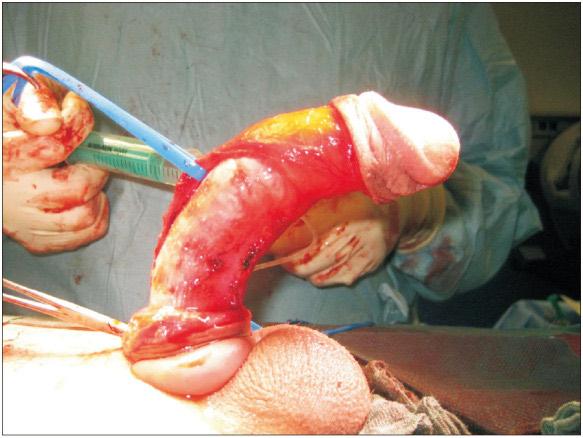
Artificial erection after penile degloving in a patient with 70° congenital curvature, with the point of maximum curvature marked on the convex side. From Sokolakis I, et al. World J Mens Health. 2020;38(4):564-572, Fig. 1 (CC BY-NC 4.0).[8]
Saline Technique
- Occlusion. A tourniquet is placed around the base of the penis. A 5 mm silicone vessel loop and a Penrose drain fashioned into a strap have both been described.[4][9]
- Needle. The Kiel plication protocol uses a 21-gauge needle and Levine a 21-gauge butterfly.[3][4] Levine places it through the glans into the corpus cavernosum, because saline that infiltrates from a shaft puncture can compromise degloving and dissection of the neurovascular bundle.[4] In a survey of 267 hypospadias surgeons, 43% injected through the glans and 56% from the lateral shaft.[10]
- Injection. In the Kiel plication protocol, 60 mL of 0.9% saline is injected after degloving, the deviation is measured, and the tourniquet is removed. The injection is repeated with a further 60 mL after the sutures are tied.[3]
- Release. The tourniquet is removed after each measurement and replaced for the next.[3]
Pressure
Saline erections reach higher pressures than drug-induced ones and vary with the force of injection. Kogan measured 50 to 250 mm Hg during saline erection, depending on the volume injected and the leak past the tourniquet, compared with 47 to 70 mm Hg during an alprostadil erection. Over-injection produced curvature that was not otherwise present, and he advised only moderate force.[7]
Two pediatric series give reference values for a full erection. Gearhart and Mostwin recorded a mean of 85.9 mm Hg in 12 boys against a systemic arterial pressure of 102 mm Hg.[11] Ben-Meir and colleagues recorded a median of 71.5 mm Hg at full erection and 283 mm Hg at rigid erection in 32 boys with coronal to penile hypospadias; pressures were lower in proximal hypospadias and after earlier corporotomies.[12]
After a graft sealed with collagen fleece, Hatzichristodoulou limits the test to about 80% of a maximal erection, because the seal is limited in this initial phase.[4]
Limits of the Tourniquet
A tourniquet leaves the base of the penis flaccid, so curvature proximal to it is missed.[7][13] Two alternatives avoid it:
- Perineal compression. Two fingers press below the symphysis while the other hand milks blood from the perineum into the penis. In 50 children assessed by both methods, curvature measured this way did not differ from curvature measured by saline injection without a tourniquet (p = 0.705).[13]
- Drug-induced erection. See below.
In a rat model, 40 minutes of penile tourniquet alone produced the most inflammation, fibrosis and endothelial dysfunction. Continuous saline infusion under the tourniquet for 20 minutes produced no fibrosis. The authors attributed the difference to washout of blood elements that contribute to reperfusion injury.[14]
Drug-Induced Erection
In a pediatric hypospadias series, an injected vasoactive agent produced an erection of the whole penis, including the base.[7]
- Alprostadil before draping. The Morey group injects 20 mcg of alprostadil into the corpus before the prep, then grips the base of the penis to judge the deformity and plan the incision. If the erection is poor, a second 20 mcg dose is given or saline is added through a butterfly needle.[3]
- Alprostadil with saline, no tourniquet. Levine injects alprostadil 20 mcg and supplements it with saline through a 21-gauge butterfly needle in the glans.[4]
- Plication under a maintained erection. Brock, Kadioglu and Lue reported 19 plications performed under a simultaneous pharmacological erection.[15]
The comparative evidence comes from pediatric hypospadias surgery. In Kogan's series of 56 boys given 14 mcg of alprostadil, erection began within 1 minute, was rated excellent in 47 and adequate in 6, and failed in 3, probably from injection outside the corpora.[7] The degree of curvature stayed constant during assessment, whereas with saline it changed with injection force. The erection persisted as long as the corpora were not opened.[7] Perovic and colleagues used 0.5 to 15 mcg of prostaglandin E1 in 672 patients aged 12 months to 47 years; 7 did not respond, the mean duration of erection was 80 minutes, and 2 patients had an erection lasting up to 6 hours.[16]
Hadidi and colleagues list increased blood loss during the erection and the need for a reversal agent as disadvantages in hypospadias surgery.[13] About one third of men with Peyronie's disease have erectile dysfunction, and those who respond poorly need further injections or saline.[3]
Detumescence
Kogan gave 40 mcg of phenylephrine for detumescence in children; it followed within seconds in every case in which the drug was given, no priapism occurred, and blood pressure and pulse did not change.[7] Ischemic priapism can lead to cavernosal fibrosis and erectile dysfunction, and the AUA/SMSNA guideline gives recommendations for intracavernosal phenylephrine.[17] Adult dosing is on the Priapism Management page.
Measuring the Curve
In a survey of 267 hypospadias surgeons, visual estimation was the predominant method and was rated the least dependable.[10] The studies below tested pediatric urologists on models and images.
| Study | Method | Finding |
|---|---|---|
| Villanueva 2019[18] | 25 urologists, nine plastic models from 10° to 90°, eyeball versus goniometer | Mean error 3.5° to 13.6°; the goniometer was no more accurate. At a 30° threshold, 15 of 25 chose the wrong operation for the 30° model |
| Mosa 2022[19] | 52 surgeons asked to show 30° with a finger | 17 of 52 (33%) were accurate; the mean error was 10°. Smartphone app goniometry matched standard goniometry (R = 0.983) |
| Kern 2023[20] | Survey of 108 pediatric urologists with image cases | In the operating room 71% used eyeball estimates alone. Curvature was underestimated in every case |
Hatzichristodoulou and Levine each measure the erect penis with a goniometer.[4] Hadidi and colleagues photographed each erection from the same angle and measured the curve with an angle app.[13]
Complications
- Hematoma, edema, postoperative pain and repeated punctures of the corpora.[13]
- False curvature from over-injection of saline.[7]
- Missed proximal curvature below the tourniquet.[7][13]
- Under-correction when the erection is poor.[3]
- Prolonged erection after a vasoactive injection.[16]
- Failed erection from injection outside the corpora.[7]
In a pediatric series of 12 boys, mean corporal pressure during a full saline erection (85.9 mm Hg) was below systemic arterial pressure (102 mm Hg).[11]
References
1. Gittes RF, McLaughlin AP 3rd. Injection technique to induce penile erection. Urology. 1974;4(4):473–474. doi:10.1016/0090-4295(74)90025-9
2. European Association of Urology. "EAU Guidelines on Paediatric Urology: Congenital Penile Curvature." 2026. https://uroweb.org/guidelines/paediatric-urology/chapter/congenital-penile-curvature
3. Cordon BH, Osmonov D, Hatzichristodoulou G, Morey AF. Peyronie's penile plication. Transl Androl Urol. 2017;6(4):639–644. doi:10.21037/tau.2017.07.18
4. Hatzichristodoulou G, Tsambarlis P, Kübler H, Levine LA. Peyronie's graft surgery—tips and tricks from the masters in andrologic surgery. Transl Androl Urol. 2017;6(4):645–656. doi:10.21037/tau.2017.07.17
5. Weinberg AC, Pagano MJ, Deibert CM, Valenzuela RJ. Sub-coronal inflatable penile prosthesis placement with modified no-touch technique: a step-by-step approach with outcomes. J Sex Med. 2016;13(2):270–276. doi:10.1016/j.jsxm.2015.12.016
6. Mydlo JH, Doumanian LR. Penile Fracture. In: Brandes SB, Morey AF, eds. Advanced Male Urethral and Genital Reconstructive Surgery. 2nd ed. Humana Press; 2014:625–640. doi:10.1007/978-1-4614-7708-2_44
7. Kogan BA. Intraoperative pharmacological erection as an aid to pediatric hypospadias repair. J Urol. 2000;164(6):2058–2061. PMID 11061925
8. Sokolakis I, Schönbauer P, Mykoniatis I, et al. Long-term results after surgical treatment of congenital penile curvature using a modified Nesbit technique. World J Mens Health. 2020;38(4):564–572. doi:10.5534/wjmh.190092
9. Khogeer A, Alzahrani A, Ibrahim A, Aubé-Peterkin M, Carrier S. Novel penile compression technique of penile surgeries "Penile strap". Arch Ital Urol Androl. 2023;95(1):11201. doi:10.4081/aiua.2023.11201
10. Abbas TO, Sennert M, Tiryaki S, et al. Hypospadias-associated penile curvature assessment and management: a global survey of current practice. J Pediatr Urol. 2024;20(3):440.e1–440.e10. doi:10.1016/j.jpurol.2024.02.006
11. Gearhart JP, Mostwin JL. Intracorporeal pressure monitoring during artificial penile erection. J Urol. 1989;142(4):1063–1064. doi:10.1016/s0022-5347(17)38989-9
12. Ben-Meir D, Abu Sbaih F, Frumer M. Intracavernosal pressure of the erect penis in children with hypospadias. Int J Impot Res. 2024;36(1):68–71. doi:10.1038/s41443-023-00788-0
13. Hadidi AT, Fawzy M, Sennert M, Wirmer J. The natural (non-invasive) erection test: is it a reliable alternative to the artificial erection test? J Pediatr Urol. 2023;19(6):702–707. doi:10.1016/j.jpurol.2023.08.009
14. Karagöz Hakalmaz A, Çomunoğlu N, Şahin H, Koyutürk M, Emir H. The effect of penile tourniquet and continuous artificial erection on penile erectile tissues: an experimental study. J Pediatr Urol. 2026;22(5):105643. doi:10.1016/j.jpurol.2025.10.010
15. Brock G, Kadioglu A, Lue TF. Peyronie's disease: a modified treatment. Urology. 1993;42(3):300–304. doi:10.1016/0090-4295(93)90619-l
16. Perovic S, Djordjevic M, Djakovic N. Natural erection induced by prostaglandin-E1 in the diagnosis and treatment of congenital penile anomalies. Br J Urol. 1997;79(1):43–46. doi:10.1046/j.1464-410x.1997.27010.x
17. Bivalacqua TJ, Allen BK, Brock G, et al. Acute ischemic priapism: an AUA/SMSNA guideline. J Urol. 2021;206(5):1114–1121. doi:10.1097/JU.0000000000002236
18. Villanueva CA. Goniometer not better than unaided visual inspection at estimating ventral penile curvature on plastic models. J Pediatr Urol. 2019;15(6):628–633. doi:10.1016/j.jpurol.2019.09.020
19. Mosa H, Paul A, Solomon E, Garriboli M. How accurate is eyeball measurement of curvature? A tool for hypospadias surgery. J Pediatr Urol. 2022;18(4):470–476. doi:10.1016/j.jpurol.2022.04.009
20. Kern NG, Tuong MN, Villanueva C, Gargollo P, Herndon CDA. Pediatric urologists' confidence and accuracy in estimating penile curvature. J Pediatr Urol. 2023;19(2):180.e1–180.e6. doi:10.1016/j.jpurol.2022.11.004