Heineke-Mikulicz Technique
The Heineke-Mikulicz technique is a reconstructive principle in which a longitudinal incision across a short luminal narrowing is closed transversely (at 90°), widening that lumen without graft harvest. Independently described by Walter Hermann Heineke (1886) and Johann von Mikulicz-Radecki (1887) as a pyloroplasty, the principle has been adapted to selected urethral strictures and ureteropelvic-junction obstruction.[1][2] In genital-skin applications, the incision and closure axes depend on the structure and the desired direction of lengthening; the penoscrotal-web repair below uses the reverse orientation. Related geometric techniques include Y-V plasty (advancement) and Z-plasty (transposition).
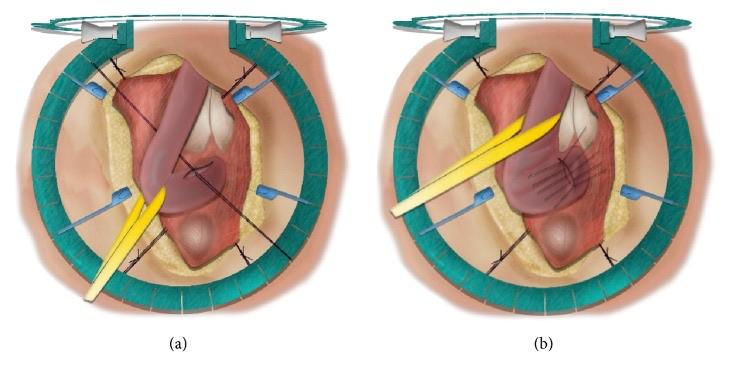
Heineke-Mikulicz stricturoplasty: (a) longitudinal incision across the stricture; (b) transverse closure of the incision, widening the lumen while slightly shortening the segment. The same geometry applies wherever tissue is mobile and well vascularized. From Verla W, et al. Biomed Res Int. 2019;2019:9046430, Figure 7 (CC BY).[2]
Geometric Principle
Three ideas define the technique:[1][2]
- Incise long, close transverse. A longitudinal cut along the axis of a tubular structure, carried across the stenosis into healthy tissue at both ends, is then sutured perpendicular to its original axis. The wound's midpoints are drawn apart while its ends are brought together.
- Caliber is traded for length. The closure widens the cross-section at the former narrowing while modestly shortening the segment. The gain is bounded by how far the transverse closure will stretch, so the technique only works for short narrowings.
- Full transection may be avoided. In a suitable urethral repair, the segment is incised rather than fully divided, preserving more native continuity; the actual blood supply still depends on tissue quality and dissection. This is not a guarantee of perfusion in scarred or previously operated tissue.
Origin
Heineke and Mikulicz independently introduced the maneuver as a pyloroplasty, a gastric drainage procedure, in the 1880s.[1] For Crohn-related small-bowel strictures, Heineke-Mikulicz strictureplasty is the most common technique for short segments (<10 cm); Finney is commonly used for medium segments (10–20 cm), and Michelassi is described for long segments (>20 cm).[19] In genitourinary reconstruction the same principle is borrowed wherever a short, focal narrowing can be opened and re-closed without resection.
Applications in Reconstructive Urology
Male urethral stricture — non-transecting "stricturoplasty"
Lumen and colleagues formally applied the principle to the urethra as a ventral longitudinal stricturotomy with transverse closure.[3] Because the fibrotic segment is incised rather than excised and the urethra is never transected, it is a non-transecting repair, sometimes called a stricturoplasty rather than a true urethroplasty.[2] Candidate selection is strict: a short (<1 cm), not-too-narrow, minimally fibrotic stricture of the bulbar urethra or fossa navicularis. In the original 10-patient series, 9/10 (90%) were classified as successfully treated at mean 46.6-month follow-up (range 15–79); one patient reported mild chordee and shortening, and another reported postvoid dribbling.[3]
A more recent extension is the double-sided Heineke-Mikulicz urethroplasty for short (3–20 mm) strictures around the penoscrotal junction: the authors describe ventral and dorsal wall incisions without substitute tissue. In the initial 11-patient series, the distal to mid-bulbar urethra was circumferentially mobilized in the five patients with longer strictures. Nine patients (81.8%) had durable success at a median 33 months (range 18–39), and three reported slight shortening without impairment of sexual activity on the Sexual Health Inventory for Men.[4]
Where it sits in the ladder: this is a selected small-series technique. The AUA urethral-stricture guideline mentions Heineke-Mikulicz closure only in its definition of urethroplasty and makes no technique-specific recommendation for it. Guideline-level choice for a short bulbar stricture is broader and depends on location, length, spongiofibrosis, prior treatment and available tissue; longer disease may require substitution urethroplasty.[5]
Female urethral stricture — meatoplasty
For a short isolated female meatal stricture, the 2026 EAU guideline weakly recommends meatotomy/meatoplasty.[15] Waterloos and Verla describe the Heineke-Mikulicz variant for very short (<0.5 cm) meatal strictures; longer repairs can create a hypospadiac meatus with vaginal voiding and irritation.[6] They advise against this repair with lichen sclerosus because the disease may affect the reconstructed meatus.[6] Waterloos and Verla describe a ventral longitudinal incision carried to healthy urethral mucosa admitting a 20 Fr catheter, followed by separate transverse sutures from urethral to vaginal mucosa to widen the outlet without a flap or graft.[6] See Female Urethral Stricture.
Ureter and ureteropelvic junction
The principle is the basis of the non-dismembered Fenger pyeloplasty: in selected short ureteropelvic-junction narrowings, a longitudinal incision is closed transversely without dividing the UPJ. In Janetschek’s 65-patient mixed-age series, 79% had ventrally crossing vessels; the surgeons displaced the vessels from the UPJ before the nondismembered repair.[13] In one laparoscopic series, 63/67 obstructed UPJs underwent Fenger plasty and 4/67 underwent Y-V plasty; 47/48 patients available for follow-up (of 65 treated; mean 25 months) had a successful result in this pooled nondismembered cohort.[13] The related Foley Y-V pyeloplasty uses advancement geometry for different anatomy.[13] In a separate, small nonrandomized pediatric series without crossing-vessel obstruction, obstruction resolved after 3/7 Heineke-Mikulicz repairs versus 18/19 dismembered repairs; 4/7 Heineke-Mikulicz patients developed acute flank pain within three days of stent removal.[16] The groups were treated with different operations and are not directly comparable to Janetschek’s mixed-age cohort.[16] In the ureter proper, Tsivian reported one case, a ureterocutaneous fistula after earlier retroperitoneal tumor removal, in which the maneuver bridged the gap between the ureteral edges and avoided more morbid measures in that patient; it is not a broadly validated answer to extensive ureteral loss.[7] See Ureteroureterostomy and UPJ Obstruction.
Genital skin
- Preputioplasty. This is a foreskin-preserving option for selected adults with phimosis. In one seven-patient, single-surgeon retrospective series, a dorsal vertical incision over the phimotic band (adding a ventral incision in two patients) was closed horizontally; one patient reported recurrent bothersome phimosis at a median follow-up of only 1.8 months and was treated with triamcinolone. Longer-term durability is not established by this series.[8]
- Penoscrotal web (scrotoplasty). A transverse incision closed vertically can release a tethering web and lengthen ventral shaft skin; this reverses the incision and closure axes of the classic luminal stricturoplasty. In a prospective study that randomly allocated 40 uncircumcised children, Heineke-Mikulicz repair took less operative time than Z-plasty. Through 12 months, recurrent webbing occurred in 3/20 Heineke-Mikulicz patients and 1/20 Z-plasty patient (Fisher exact p = 0.605); the three Heineke-Mikulicz patients required revision Z-plasty, whereas the Z-plasty patient had mild curvature without reoperation.[9]
Urethral diverticulum
A single recurrent male urethral diverticulum with calculus formation, after repeated excision and repair, was reconstructed with defect excision followed by Heineke-Mikulicz closure; its authors reported no recurrence, with the only dated follow-up assessment being a three-month cystoscopy that showed a well-healed repair.[10]
Transmasculine / gender-affirming reconstruction
For a selected short neourethral stricture after phalloplasty or metoidioplasty, the Heineke-Mikulicz repair is one reconstructive option. A 2026 systematic review of heterogeneous retrospective series reported recurrence reaching approximately 50% across one-stage urethroplasties, particularly nonaugmented techniques such as Heineke-Mikulicz.[17] A separate two-center retrospective pars fixa series reported that 44% of 16 Heineke-Mikulicz repairs avoided repeat intervention after at least 12 months; its outcome definition differs from the composite success measure in the seven-repair series below.[18] A single-center retrospective cohort reported six successful repairs among seven selected Heineke-Mikulicz neourethral strictures.[11][12] In that cohort, success combined satisfactory standing voiding without obstructive symptoms or objective obstruction and no need for further surgery; the 61-month median follow-up covered all 72 patients, without a repair-specific interval.[12] The EAU urethral stricture guideline (2026) lists Heineke-Mikulicz urethroplasty as an option for very short (<1.5 cm), low-grade strictures at the anastomosis between the neophallic urethra and the fixed urethra.[14] It strongly recommends against endoscopic incision or urethroplasty within six months after neophalloplasty while healing and scar maturation are incomplete.[14] See Revision and Salvage in Gender-Affirming Surgery.
Patient Selection and Limitations
| Potential fit | A short, focal luminal narrowing with healthy, mobile tissue; site-specific evaluation remains necessary. |
| Limits | Long, dense, obliterative or multifocal disease may not permit a useful tension-free transverse closure; alternative reconstruction is selected by anatomy and etiology, not one universal length cutoff. |
| Relatives | Y-V plasty (advancement — bladder-neck contracture, VUAS, Foley pyeloplasty, meatoplasty); Z-plasty (transposition — scar lengthening/reorientation); Finney / Michelassi strictureplasties for longer bowel segments. |
For the classic luminal repair, local caliber is gained at the cost of some length, provided the tissues permit tension-free closure. Genital-skin adaptations must be described by their actual incision and closure axes rather than assuming that lumen-widening geometry applies unchanged.
See Also
- Non-Transecting Bulbar Urethroplasty
- Principles of Urethral Reconstruction
- Pyeloplasty (Fenger / Foley Y-V)
- Ureteroureterostomy
- Female Urethral Stricture
- Y-V Plasty · Z-Plasty
References
1. Lovasik BP, Dodson TF, Srinivasan JK. "Heineke, Mikulicz, Jaboulay, and Finney: Innovators of Surgical Pyloroplasty." Am Surg. 2021;87(5):737-740. doi:10.1177/0003134820952820
2. Verla W, Oosterlinck W, Spinoit AF, Waterloos M. "A Comprehensive Review Emphasizing Anatomy, Etiology, Diagnosis, and Treatment of Male Urethral Stricture Disease." Biomed Res Int. 2019;2019:9046430. doi:10.1155/2019/9046430
3. Lumen N, Hoebeke P, Oosterlinck W. "Ventral Longitudinal Stricturotomy and Transversal Closure: The Heineke-Mikulicz Principle in Urethroplasty." Urology. 2010;76(6):1478-82. doi:10.1016/j.urology.2010.06.051
4. Kanematsu A, Yanagi T, Shimatani K, Taguchi M, Yamamoto S. "Double-Sided Heinecke-Mikulicz Urethroplasty for Short Stricture Around Penoscrotal Junction: Description of Technique and Clinical Outcome of Initial Cases." Int J Urol. 2025;32(8):1064-1070. doi:10.1111/iju.70108
5. Wessells H, Morey A, Souter L, Rahimi L, Vanni A. "Urethral Stricture Disease Guideline Amendment (2023)." J Urol. 2023;210(1):64-71. doi:10.1097/JU.0000000000003482
6. Waterloos M, Verla W. "Female Urethroplasty: A Practical Guide Emphasizing Diagnosis and Surgical Treatment of Female Urethral Stricture Disease." Biomed Res Int. 2019;2019:6715257. doi:10.1155/2019/6715257
7. Tsivian A. "Reconstruction of Extensive Upper Ureteral Damage." J Urol. 2004;171(1):329-30. doi:10.1097/01.ju.0000101260.82927.5d
8. Xu AJ, Mishra K, Zhao LC. "Heineke-Mikulicz Preputioplasty: Surgical Technique and Outcomes." Urology. 2022;166:271-276. doi:10.1016/j.urology.2022.03.030
9. Elrouby A. "Evaluation of Z-plasty versus Heineke-Mikulicz Scrotoplasty in the Management of Penoscrotal Web in Pediatric Age Group." BMC Urol. 2024;24(1):66. doi:10.1186/s12894-024-01450-7
10. Jambunathan S, Subramaniam B. "Heineke-Mikulicz Principle in a Male With Failed Recurrent Urethral Diverticulum." Cureus. 2024;16(8):e67972. doi:10.7759/cureus.67972
11. Elyaguov J, Isakov R, Nikolavsky D. "Evaluation and Management of Urologic Complications Following Transmasculine Genital Reconstructive Surgery." Neurourol Urodyn. 2023;42(5):979-989. doi:10.1002/nau.25100
12. de Rooij FPW, Peters FRM, Ronkes BL, et al. "Surgical Outcomes and Proposal for a Treatment Algorithm for Urethral Strictures in Transgender Men." BJU Int. 2022;129(1):63-71. doi:10.1111/bju.15500
13. Janetschek G, Peschel R, Bartsch G. "Laparoscopic Fenger Plasty." J Endourol. 2000;14(10):889-893. doi:10.1089/end.2000.14.889
14. European Association of Urology. "EAU Guidelines on Urethral Strictures." 2026, section 8.1.4 (strictures at the neophallic urethra to fixed urethra anastomosis).
15. European Association of Urology. "EAU Guidelines on Urethral Strictures: Disease Management in Females." 2026. Guideline.
16. Casale P, Grady RW, Joyner BD, Zeltser IS, Figueroa TE, Mitchell ME. "Comparison of dismembered and nondismembered laparoscopic pyeloplasty in the pediatric patient." J Endourol. 2004;18(9):875-878. doi:10.1089/end.2004.18.875
17. Neuville P, Madec FX, Vetterlein MW, et al. "Systematic review of the outcomes of urethroplasty following urethral lengthening in transgender men." Int J Impot Res. 2026;38(4):302-310. doi:10.1038/s41443-025-01132-4
18. Jung H, Chen ML, Wassersug R, et al. "Urethroplasty Outcomes for Pars Fixa Urethral Strictures Following Gender-affirming Phalloplasty and Metoidioplasty: A Retrospective Study." Urology. 2023;182:89-94. doi:10.1016/j.urology.2023.07.009
19. Solitano V, Dal Buono A, Gabbiadini R, et al. "Fibro-Stenosing Crohn's Disease: What Is New and What Is Next?" J Clin Med. 2023;12(9):3052. doi:10.3390/jcm12093052