Hypospadias & Epispadias
Hypospadias is a congenital anomaly in which the urethral meatus opens proximally on the ventral surface of the penis, often with ventral curvature, deficient ventral penile skin, and a dorsally hooded foreskin.[1][2] Epispadias is a much rarer congenital malformation in which the urethral plate fails to tubularize dorsally, leaving the meatus on the dorsal penis and often placing the patient within the exstrophy-epispadias complex.[3][4]
Hypospadias and epispadias persist into adult reconstructive practice. Adults present with uncorrected distal anomalies, failed childhood repair, urethral stricture, urethrocutaneous fistula, chordee, sexual dysfunction, infertility concerns, urinary incontinence, catheterizable channels, bladder augmentation, and renal surveillance needs. The operation rarely amounts to moving the meatus. It involves scarred genital skin, urethral substitution, continence reconstruction, and transition from pediatric to adult lifelong care.
Definition and Terminology
| Condition | Core defect | Typical curvature | Reconstructive implication |
|---|---|---|---|
| Hypospadias | Ventral ectopic meatus with incomplete ventral urethral development | Ventral chordee | Adult redo surgery often means penile urethral stricture repair, fistula closure, chordee correction, and genital skin substitution |
| Epispadias | Dorsal urethral plate defect with dorsal ectopic meatus | Dorsal chordee | Adult care often centers on continence, bladder neck reconstruction, sexual function, and exstrophy-related renal surveillance |
| Bladder exstrophy-epispadias complex (BEEC / EEC) | Spectrum of failed lower abdominal wall, bladder, pelvic-ring, and urethral closure | Variable | Requires lifelong surveillance after staged reconstruction, augmentation, bladder neck surgery, or catheterizable channel creation |
Hypospadias and epispadias are usually diagnosed and repaired in childhood, but adult presentations are common in reconstructive practice because childhood repairs can fail late and uncorrected variants may remain functionally acceptable until urinary or sexual expectations change.
Hypospadias in Adults
Classification
Hypospadias is commonly classified by preoperative meatal location, then reassessed after skin release; an apparently distal meatus can prove more proximal after degloving.[1][48][73]
| Type | Meatal location | Approximate frequency | Adult surgical relevance |
|---|---|---|---|
| Distal / mild | Glanular, coronal, subcoronal, distal penile | ~70% in preoperative meatal-location classifications[1] | May be asymptomatic if uncorrected; late problems include spraying, meatal stenosis, cosmetic concern, or failed childhood repair |
| Middle | Mid-penile | ~10% in preoperative meatal-location classifications[65] | More likely to require urethral substitution if scarred from prior surgery |
| Proximal / severe | Proximal penile, penoscrotal, scrotal, perineal | ~20% in preoperative meatal-location classifications[65] | Highest risk of chordee, multiple operations, psychosexual concerns, fertility impairment, and complex adult revision |
Pediatric operative notes may also record a GMS (glans-urethral meatus-shaft) score, which combines glans and urethral-plate quality, meatal location, and penile curvature assessed intraoperatively after degloving; it was developed for the operating room because office examination, particularly of curvature, is less reliable. Validation studies in children found higher GMS scores associated with more postoperative complications.[57][58] A childhood GMS score records glans and plate quality, meatal location, and curvature at primary repair; adult reoperative planning assesses current tissue quality and scarring directly.[57][58][48]
Megameatus with intact prepuce (MIP), a distal hypospadias hidden by a complete, unretracted foreskin, has been reported in boys thought to have normal preputial development and is classically found when the foreskin is retracted at circumcision.[59] Discovering MIP does not itself require abandoning circumcision; comparative series found that prior circumcision did not complicate later repair of hypospadias with an intact prepuce, and completing a newborn circumcision after discovering distal hypospadias was not associated with added complications.[60][61] Ventral skin deficiency or chordee, by contrast, is a reason to defer circumcision, since preputial skin may be needed for the repair.[59]
The Cleveland Clinic adult presentation framework:[5]
| Category | Adult presentation | Frequency in the Cleveland Clinic series |
|---|---|---|
| Category I | Continuous multiple surgeries with significant scarring and tissue loss | 58.2% |
| Category II | Delayed complications after initially successful childhood repair | 29.1% |
| Category III | No previous repair | 12.7% |
Epidemiology
Hypospadias is one of the most common congenital anomalies in males, with an estimated incidence of 1 in 200-300 live male births.[1] Reported incidence has increased in some populations over recent decades, although ascertainment, registry methods, environmental exposures, and diagnostic threshold all complicate interpretation.[1] The EAU 2026 paediatric guideline cites a European registry prevalence of 18.6 per 10,000 male births (range 5.1–36.8), with wide regional variation worldwide.[48]
Adults presenting to reconstructive practices are typically in early to middle adulthood. Contemporary adult series report a median age of 37 years in an operative cohort and a mean presentation age of 34.6 years in a complication cohort, often decades after childhood reconstruction.[5][6]
Etiology and Developmental Biology
Hypospadias is multifactorial. Normal urethral development requires coordinated androgen signaling, urethral-fold fusion, glanular urethral canalization, corporal development, and ventral penile skin formation.[1][2]
Important contributors include:
- Genetic factors. Familial clustering is recognized; variants in androgen metabolism and genital tubercle development pathways are implicated.
- Androgen signaling disruption. Inadequate androgen production, conversion, receptor signaling, or local tissue response can impair urethral-fold fusion.
- SRD5A2 variants. One selected 33-patient Chinese series found variants in 15/25 patients with posterior hypospadias.[7]
- Environmental factors. Endocrine disruptors have been proposed, but their contribution to human hypospadias remains debated.[1]
- Associated anomalies. Proximal hypospadias with cryptorchidism, bifid scrotum, micropenis, or atypical genitalia should prompt consideration of a disorder/difference of sex development pathway.
Adult Presentation
Adults fall into two practical groups: uncorrected hypospadias and complications of prior repair.
Uncorrected Hypospadias
Many adults with uncorrected distal hypospadias are asymptomatic or well adapted. In a survey of 56 adults with hypospadias, including nine with failed or incomplete childhood repairs, 32% were unaware they had a congenital anomaly, only 5% expressed dissatisfaction with appearance, and 36% reported angulation or spraying, although only 5% sat to void.[8] The EAU 2026 guideline notes conflicting natural-history data and that more than half of the men in the more recent untreated series opted for surgical correction.[48]
That older reassurance should be balanced against newer adult-centered observations: men with uncorrected hypospadias can be more bothered by genital difference, urinary spraying, sexual function, or penile appearance than early surgical series suggested.[9] Adult repair should be driven by symptoms, anatomy, expectations, and tissue quality.
Complications of Childhood Repair
Adults after childhood repair most often present with voiding dysfunction, urethral stricture, fistula, recurrent infection, chordee, or dissatisfaction with genital appearance.[5][6]
| Presenting problem | Reported frequency / pattern | Reconstructive concern |
|---|---|---|
| Lower urinary tract symptoms | 49% as a presenting complaint among 93 adults in Hoy; 45/55 (81.8%) with any voiding symptom in Ching[5][6] | Often reflects stricture, diverticulum, hair-bearing neourethra, or bladder dysfunction |
| Spraying / split stream | Spraying in 24% of 93 adults in Hoy; split stream not separately quantified[6] | Meatal stenosis, glans dehiscence, irregular neomeatus, or distal stricture |
| Urethrocutaneous fistula | ~18% in Hoy[6] | Requires stricture exclusion before closure |
| Recurrent UTI | 15% of 93 adults overall and 19% of 74 repaired in childhood in Hoy; 20/55 (36.4%) overall in Ching[5][6] | Look for obstruction, diverticulum, stones, hair, post-void residual, or catheterizable-channel issues |
| Chordee | ~14% overall in Hoy[6] | Requires erection assessment; may need staged straightening before urethral reconstruction |
| Cosmetic dissatisfaction | 16% of 19 unrepaired versus 4% of 74 repaired in childhood in Hoy[6] | Must be separated from functional goals and realistic tissue constraints |
| Urethral stricture | 11% of 19 unrepaired versus 47% of 74 repaired in childhood in Hoy[6] | Most common adult indication for hypospadias-related urethroplasty |
The EAU 2026 paediatric guideline, citing a systematic review of adults with hypospadias-related urological issues, gives wider ranges: stricture 45–72%, LUTS 50–82%, fistula 16–30%, recurrent UTI 15–25%, ventral curvature 14–24% and lichen sclerosus 8–43%.[48]
Childhood surgery changes the adult disease phenotype. Compared with unrepaired adults, previously operated patients have higher rates of urethral stricture, recurrent UTI, and LUTS, and their strictures are significantly longer in some series (5.5 cm versus 3.0 cm).[6] Lichen sclerosus / balanitis xerotica obliterans is also over-represented in adults with hypospadias who were not previously repaired in the Cleveland Clinic cohort.[5]
An enlarged prostatic utricle or other Müllerian remnant may present with post-void dribbling, recurrent UTI, or difficult catheterization; in a retrospective series of 30 children aged 9–34 months with posterior hypospadias, 12/30 (40%) had enlarged utricles, with a descriptive increase across more proximal subtypes. All were initially asymptomatic, and 3 of 8 conservatively managed patients with an enlarged utricle became symptomatic after repair.[49]
Adult Evaluation
Adult evaluation documents the current anatomy and the childhood operative history, which is often unknown. Ask specifically about number of operations, stents/catheters, fistula repairs, chordee repair, skin grafts/flaps, infections, urinary retention, and prior dilation or urethrotomy.
Core assessment:
- Penile examination. Meatal location, glans configuration, skin quality, lichen sclerosus, hair-bearing skin, fistulae, scars, prior flap territories, ventral skin shortage, and penile length.
- Erection-time curvature. Patient photographs, induced erection, or intracavernosal injection when operative correction is considered.
- Uroflowmetry and PVR. Low plateau flow or elevated residual suggests obstruction.
- RUG / VCUG. Defines stricture length, diverticulum, fistula, and proximal urethra.
- Cystourethroscopy. Evaluates distal meatus, hair, stones, diverticulum, stricture caliber, and proximal urethra.
- Sonourethrography. Useful when the extent of spongiofibrosis may exceed the fluoroscopic lumen, especially in post-hypospadias penile strictures.
- Pelvic / transabdominal ultrasound. Can identify an enlarged prostatic utricle, seen as a midline teardrop-shaped cystic structure communicating with the urethra, when recurrent UTI or difficult catheterization raises suspicion.[49]
- Urine culture. Treat infection before reconstruction.
- Semen and endocrine assessment. Appropriate in severe/proximal hypospadias, infertility concern, cryptorchidism history, or pubertal endocrine concerns.[10][11]
Urethral Stricture Management
Urethral stricture is the most common adult surgical indication after hypospadias repair. The 2023 AUA urethral stricture guideline recommends that surgeons offer urethroplasty for penile urethral strictures given the expected high recurrence rate with endoscopic treatment . The AUA recommendation for simple dilation/meatotomy of an uncomplicated first meatal/fossa stricture excludes previous hypospadias repair, LS and prior failed interventions; these require an individualized reconstructive strategy.[12]
| Approach | Typical role | Reported outcome pattern |
|---|---|---|
| Two-stage urethroplasty | Complex redo hypospadias, long penile strictures, poor urethral plate, dense fibrosis, LS, hair-bearing neourethra, multiple prior operations | Commonly preferred; retrospective mixed-approach series report 83% initial success across one- and two-stage urethroplasty (Morrison), failure-free survival of 82% at 1 year and 57% at 10 years across techniques (Verla), and 26/29 (89.7%) free of additional procedures after staged repair, one-stage repair or PU (Horiguchi)[13][14][15] |
| One-stage substitution urethroplasty | Shorter, healthier strictures with usable plate and adequate vascularized coverage | Can be successful in selected patients, but patient selection is decisive[14][15] |
| Buccal mucosa graft | Preferred graft for staged or substitution repair | In one 32-patient adult reoperative series, skin grafts were associated with more recurrence than buccal mucosa grafts; buccal mucosa avoids a hair-bearing urethral lining[13][16] |
| Perineal urethrostomy | Elderly patients, severe scarring, multiple failures, patient preference, or desire to avoid multistage penile reconstruction | Durable salvage option[16] |
Operative principles:
- Do not close a fistula until distal obstruction and stricture are excluded.
- Avoid anastomotic excision-and-primary-anastomosis for most penile post-hypospadias strictures; penile shortening, chordee, and recurrence risk are high, with poor outcomes reported in failed-hypospadias cohorts.[14]
- Remove hair-bearing urethra, stones, diverticula, and diseased plate when they drive infection or obstruction. For isolated hairs, endoscopic laser epilation has been described; for more extensive growth, urethrotomy followed by either replacement with nonhair-bearing tissue or attempted depilation (for example, dilute thioglycolate instilled into the neourethra) with close follow-up for regrowth has been reported in a case of recurrent hairball and stone after multiple urethroplasties.[54]
- Correct chordee before committing to urethral tubularization.
- Use well-vascularized coverage over suture lines: dartos, tunica vaginalis, local fascia, or staged open graft bed as anatomy allows.
- Counsel that "success" may require several operations and long follow-up.
Some expert-center series find no detected adult–pediatric difference. One comparison included only eight adult primary repairs, while the EAU 2026 guideline cites a prospective controlled study in which the complication rate after primary TIP was 2.5 times higher in adults than in children.[48] Reoperation, proximal anatomy and scarring materially affect risk.[17][18] A 620-patient adult distal-repair series reported 12.7% postoperative complications.[40] A separate 111-patient primary-repair cohort older than 14 years, including 22 proximal cases and 30 with curvature of at least 30°, reported 83/111 (74.8%) meeting its HOPE appearance-score threshold during follow-up through 12 months.[50] This success endpoint is distinct from the separately reported postoperative complications.[50] Adult outcome reports span different meatal positions, curvature, repair histories, techniques, follow-up durations, and endpoints.[17][40][50]
Master Decision Framework for Adult Repair
Technique selection for adult hypospadias is organized around four anatomical and clinical variables: (1) meatal location (distal versus proximal), (2) presence and severity of chordee, (3) primary versus reoperative status, and (4) tissue quality (urethral plate, genital skin, prior grafts, lichen sclerosus).[17][39][48]
Distal hypospadias (glanular, coronal, subcoronal)
Primary distal hypospadias with a usable urethral plate and minimal curvature is usually suitable for one-stage repair. Prior repair, curvature, glans anatomy and tissue quality can change that plan.[40][48]
Tubularized incised plate repairOriginal schematic · v2026-09-11 · Clinical review pendingA midline plate incision allows a selected urethral plate to widen before tubularization, with vascularized coverage shown over the neourethra.View: Hypospadias, ventral view with plate sections. Scale: Conceptual schematic; not to scale. Units: No measured geometry; any dimensions are illustrative.Limits: Incision depth, plate suitability, glans closure and coverage are patient-specific. This is not a universal repair for every meatal position or curvature.Source check: 2026-09-11. This is an editorial check with the access limits below. No named clinician has signed off.EAU Paediatric Urology — 2026 guideline. Access: official guideline landing page. Source mapped for congenital anatomy, pyeloplasty and reimplantation. Exact operative construction requires chapter-level clinical verification.WARWIKI original vector schematic; individual illustrator not recorded. No separate figure reuse license recorded; linked sources are concept references, not artwork licenses.Open original SVG with embedded source record ↗
A midline plate incision allows a selected urethral plate to widen before tubularization, with vascularized coverage shown over the neourethra. Incision depth, plate suitability, glans closure and coverage are patient-specific. (Original WARWIKI schematic; see the figure source record and review limits.)
| Technique | Role | Outcome pattern |
|---|---|---|
| Tubularized Incised Plate (TIP / Snodgrass) | Default single-stage approach | A retrospective adult/adolescent distal-TIP series (age >16; n = 620) reported 12.7% complications; it did not compare TIP with Mathieu[40][39] |
| Mathieu (meatal-based flap) | Alternative single-stage when urethral plate is thin or narrow | Selection depends on plate, glans and flap anatomy |
| MAGPI (meatal advancement and glanuloplasty) | Most distal (glanular) variants only, minimal chordee | Limited adult applicability |
| Glans approximation procedure (GAP) | Historically described Thiersch-Duplay plate-tubularization option for a glanular/coronal meatus with a deep glandular groove | Original series was 24 children with no reported meatal or urethral stenosis at 3-18 months; no adult outcome series exists[55] |
Proximal hypospadias (penile shaft, penoscrotal, scrotal, perineal)
The most challenging category. In 167 boys with a meatus at or proximal to the penoscrotal junction after degloving, 93/167 (56%) developed a complication over follow-up (median 31.7 months for the cohort).[39][41] The decision pivots on chordee severity and urethral plate quality:
- No or mild chordee, intact urethral plate: single-stage extended TIP (with or without dorsal inlay graft) or onlay island flap.[39][42] The EAU 2026 paediatric guideline calls the use of TIP for proximal hypospadias a matter of debate, advises TIP only when curvature is absent or below 30 degrees, and describes the preputial island onlay as a good option for proximal hypospadias or an unsuitable plate for tubularization.[48]
- Moderate-to-severe chordee (≥30°) requiring urethral plate transection: staged repair is often selected after straightening in pediatric proximal repair[39][48]; a 32-adult reoperative cohort also used two stages in 90% of urethroplasties.[13] Bracka-type free-graft repair is one staged option.[46] A meta-analysis of proximal hypospadias repair reported complications in 414/1,984 (21%) patients after two-stage foreskin free-graft or pedicled-flap repair versus 285/680 (42%) after single-stage foreskin pedicled-tube repair (mean follow-up 4.5 years; substantial between-study heterogeneity).[48][72] The EAU 2026 paediatric guideline states that staged procedures have become preferable over the past few years because of lower recurrence of ventral curvature.[48]
- Stage 1. Chordee correction, urethral plate transection if needed, placement of a free graft (buccal mucosa or preputial skin) as a neourethral plate on the ventral surface.
- Stage 2 (about 6 months later). Tubularization of the grafted plate to create the neourethra.
A tunneled buccal mucosa tube graft has been described after penile-shaft optimization at a prior stage. In the 37-patient report, 11/34 with more than one year of follow-up had complications, and functional testing was available in only 13/37.[43]
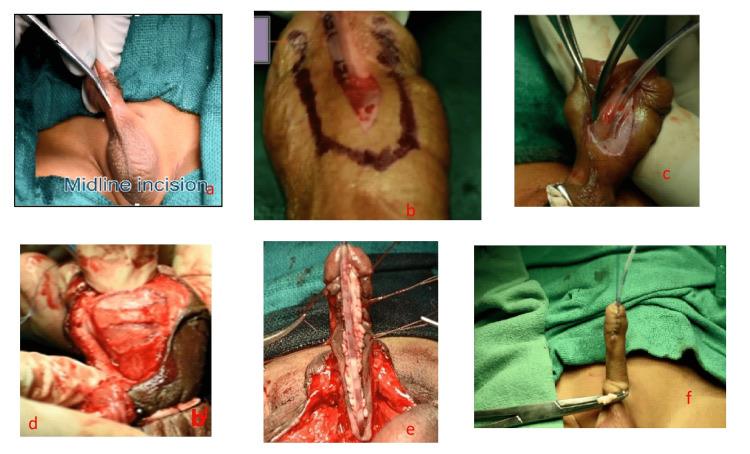
Operative steps of an adult hypospadias repair. (a) Midline incision of the hypoplastic urethra. (b) Incision extended to the mid-glans. (c) Vertical deepening of the incision to Buck's fascia. (d) Ventral corporotomies. (e) Urethral plate augmented with two buccal mucosa grafts. (f) Prepucioplasty. From Arya MC, et al. Cureus. 2023;15(8):e44021, Figure 3 (CC BY).[50]
Reoperative / failed hypospadias
Adults presenting with stricture, fistula, persistent hypospadias, hair-bearing urethra, or residual chordee after childhood repair represent the most complex subgroup. In a review of a prospective urethroplasty database of 50 adults referred for complications of childhood hypospadias repair, urethral stricture was the most common presenting complication (36 of 50, 72%), followed by urethrocutaneous fistula (12), persistent hypospadias (7), hair in the urethra (6) and severe chordee (7); the series is also cited above for its 76% eventual success rate after additional procedures.[44] Long, complex stricture in this population is associated with worse tissue quality and increased fibrosis from the prior surgery.[6][44] A multicenter series of 1,176 patients evaluated for failed hypospadias repair (mean age 31) found that most required either repeat one-stage repair (64.6%) or a staged approach (35.4%), and 88.1% eventually reached a successful outcome only after completion of all secondary procedures; adults reaching a reconstructive urologist for failed hypospadias have typically already had more than one prior operative attempt.[52]
- Staged repair is commonly used for complex adult reoperation. In the 32-patient Morrison cohort, staged repair accounted for 90% of urethroplasties; 83% initial success pooled staged and one-stage procedures, median follow-up was 9.5 years, and graft choices included skin and buccal mucosa.[13] In a separate 79-patient cohort (mean follow-up 48 months), 48 underwent staged BMG repair and 31 one-stage distal repair.[18] Among staged patients, eight required first-stage revision, nine developed fistula after stage 2, and two required repeat urethroplasty within three years; six one-stage patients required fistula closure.[18] One institutional practice places the onlay graft laterally, at either the 3 or 9 o'clock position with fixation sutures to the corpus cavernosum, specifically to avoid a curved neourethra in salvage reconstruction.[56]
- Penile skin coverage. When local penile skin is inadequate, a scrotal fasciocutaneous rotation flap has been described for resurfacing. In one center's experience across 193 complex hypospadias repairs, it was used in 47 cases; the distal flap was judged reliable in 45 of 47, with two distal-flap-end necroses accompanying dehiscence of the distal urethroplasty. Among 43 of the 51 scrotal-skin recipients with longer-term follow-up, 10 (23%) later required flap revision (four for late scarring, four for a dog-ear deformity, and two using tissue expansion for iatrogenic penoscrotal webbing or aesthetic concerns).[66]
- One-stage distal urethroplasty is an option for selected isolated distal complications (single fistula or short stricture). For distal strictures after failed hypospadias repair, a 2026 meta-analysis of 20 heterogeneous studies reported pooled success of 78.1% with one-stage and 76.2% with staged repair, without a statistically significant difference; tissue quality remains central to selection.[18][44][64]
- Perineal urethrostomy is a legitimate definitive option for elderly patients, multiply failed repairs, or those who decline complex reconstruction. The 2023 AUA Urethral Stricture Guideline states that surgeons may offer PU as a long-term alternative to urethroplasty and should offer it in populations at high risk of failure of urethral reconstruction .[12] In one series, 4/29 (13.8%) adults with hypospadias-related strictures underwent PU; across all reconstructive approaches, 23/25 patient-reported-outcome respondents (92%) were satisfied or very satisfied.[15]
- Risk rises with each prior operation. In a pediatric cohort, complications occurred after primary TIP in 135/1085 (12%) and after reoperative TIP in 61/191 (32%), inlay in 16/46 (35%), and two-stage repair in 49/124 (40%). The authors also reported that a single reoperation roughly doubled complication risk versus primary repair, with about 40% risk after three or more reoperations; each prior surgery was associated with 1.5-fold higher odds of another complication (OR 1.51). They proposed reduced vascularity of previously operated tissue as an explanation.[51] This pediatric-cohort escalation curve is the basis for counseling an adult considering yet another reoperation after multiple prior failed repairs.[51]
Graft material selection
Buccal mucosa is commonly selected for adult salvage reconstruction. For failed repair with lichen sclerosus or scarred penile skin, the EAU 2026 urethral stricture guideline recommends against penile skin grafts or flaps for urethral substitution .[48] In a survey of 134 GURS respondents about urethral-stricture repair, 99% preferred buccal mucosa as their primary graft harvest site, and respondents favored BMG over fasciocutaneous flaps for penile urethroplasty regardless of circumcision status.[45] In the Morrison series, skin grafts were significantly associated with stricture recurrence compared with BMG.[13] A retrospective pediatric comparison used different eras (108 preputial grafts in 2001–2013 versus 112 buccal grafts in 2013–2016), with complications in 31% versus 20%.[46] A randomized trial enrolled 98 adults with extensive anterior strictures and analyzed 92; at its 12-month primary endpoint, success (no voiding LUTS, patent urethra on retrograde urethrography and no further intervention) was 93.2% with penile skin versus 97.9% with BMG (p = 0.346), with median follow-up of 20 months, but excluded LS, fistula, diverticulum and unsalvageable scarred plates.[47]
Prognostic factors
| Factor | Impact on outcome |
|---|---|
| Meatal location (proximal) | Major risk factor. Complications reached 56% in one 167-boy proximal series[41]; the EAU 2026 paediatric guideline gives a range of 14–68% for proximal repairs[48] |
| Reoperation status | 33% vs 14% in a mixed adult–pediatric single-surgeon cohort[17]. The EAU 2026 paediatric guideline gives about 23.3% for redo versus 12.2% for primary repairs[48] |
| Adult vs pediatric age | Conflicting comparative evidence |
| Graft type (skin vs BMG) | Skin grafts associated with higher recurrence in complex cohorts |
| Surgeon experience | Higher surgeon volume is associated with lower complication rates in pediatric hypospadias series[48] |
| Stricture length | No association with recurrence detected in one 32-patient adult reoperative cohort[13] |
Long-term outcomes and surveillance
In an 85-patient adult failed-hypospadias stricture series using additional urethral manipulation for recurrent stricture as the failure endpoint, failure-free survival for the cohort declined from 82% at 1 year to 57% at 10 years (median follow-up 89 months), supporting prolonged surveillance.[14] In a 20-study systematic review, men who underwent hypospadias repair in childhood reported more urinary symptoms and had lower Qmax than controls;[75] registered fatherhood was 24.0% among 1,083 Danish men operated for hypospadias versus 29.4% among age-matched controls, while semen measures in 89 evaluable men with isolated hypospadias did not differ statistically from controls in a separate clinical sample[74]; and psychosexual outcomes are particularly affected in proximal hypospadias.[39] Long-term follow-up after childhood repair is supported by a 1,280-patient pediatric primary-repair cohort: complications requiring unplanned surgery occurred in 10.7% of distal, 18.8% of mid-shaft and 53.8% of proximal cases; only 47% were detected in the first postoperative year, with median detection at 69.2 months overall (83.1 after distal and 29.4 after proximal repair).[53]
Summary algorithm
- Distal, primary, no chordee: single-stage TIP (or Mathieu)
- Proximal, no / mild chordee: consider single-stage extended TIP, with or without dorsal inlay graft, when the plate is suitable and curvature is <30°; a preputial island onlay flap is another proximal option, particularly when the plate is unsuitable for tubularization.[39][42][48]
- Proximal, moderate-to-severe chordee: correct curvature first and divide the plate if needed; consider staged repair with healthy preputial skin or buccal mucosa according to tissue quality and prior surgery.[46][48]
- Reoperative / complex: refer failed repair to a specialist center . Use staged buccal mucosa graft urethroplasty when the plate or surrounding tissues are inadequate; selected isolated distal complications may be repaired in one stage.[48]
- Multiply failed / elderly / patient preference: perineal urethrostomy as definitive management[12]
Sexual Function and Psychosexual Outcomes
Adult outcomes are heterogeneous because severity, number of operations, chordee, penile size, cosmesis, and partner experience all vary. Reported erectile dysfunction rates range widely, and sexual dissatisfaction is more common in proximal or multiply operated patients.[19][20][21][22]
| Domain | Pattern |
|---|---|
| Erections | Most men can have penetrative sex, but ED rates vary by series and severity |
| Ejaculation | A low-response-rate cohort of 119 respondents from a 1978-1993 childhood-repair program found premature ejaculation in 83.2% overall and mild erectile dysfunction in 8.9% of the glanular, 50% of the distal and 72.2% of the proximal subgroup[22] |
| Penile length / appearance | Proximal hypospadias is associated with greater concern about penile length and appearance |
| Physical contact | Some adolescents and adults with proximal hypospadias report uncertainty or avoidance around genital contact |
| Satisfaction with repair | Many men are satisfied with childhood repair, especially after uncomplicated surgery; multiple surgeries predict poorer psychosexual outcomes |
The practical adult consultation should address urinary goals, sexual goals, appearance goals, and the patient's own language for distress; the EAU weakly recommends psychological or psychosexual counseling for men with unsatisfactory cosmesis and sexual or urinary dysfunction related to failed hypospadias repair.[48] Reconstructive options can improve obstruction and fistula.
Fertility and Endocrine Outcomes
Hypospadias can be part of a broader testicular dysgenesis phenotype. In a young adult cohort of nonsyndromic hypospadias, oligozoospermia or azoospermia occurred in 32/172 men who provided semen (18.6%), with higher rates in complex hypospadias and in men born small for gestational age.[10] A Western Australian population linkage study found lower registered paternity among men with hypospadias (adjusted hazard ratio 0.79, 95% CI 0.71–0.89).[23]
Mechanisms may include impaired spermatogenesis, cryptorchidism, altered Leydig cell function, ejaculatory dysfunction, genital self-image, or reduced sexual opportunity.[10][11] Young adults with severe hypospadias, cryptorchidism, or infertility concern should be offered semen analysis and endocrine evaluation.[10][11]
Epispadias in Adults
See the dedicated Bladder Exstrophy-Epispadias Complex page for continence reconstruction, diversion, malignancy surveillance, pregnancy, and lifelong follow-up.
Classification and Spectrum
Epispadias exists on a spectrum within the exstrophy-epispadias complex.[3][4][24]
| Condition | Severity | Approximate prevalence | Adult reconstructive burden |
|---|---|---|---|
| Isolated epispadias | Mildest | ~1 in 117,000 | Dorsal urethral reconstruction, chordee correction, and continence assessment |
| Classic bladder exstrophy | Intermediate | ~1 in 30,000 | Bladder closure, epispadias repair, bladder neck reconstruction, augmentation, catheterizable channel, renal surveillance |
| Cloacal exstrophy | Most severe | ~1 in 200,000 | Multisystem reconstruction involving GU, GI, abdominal wall, pelvic ring, and continence pathways |
EAU 2026 estimates 1 in 30,000–50,000 live births for epispadias plus classic bladder exstrophy, with male predominance.[69] The isolated-epispadias estimate above is male-specific; the subtype frequencies are approximate historical estimates that vary by source and ascertainment.[4][71]
Male epispadias is classified by the dorsal meatal location:[3][25]
- Glanular epispadias. Meatus on the dorsal glans; mildest.
- Penile epispadias. Meatus on the dorsal penile shaft.
- Penopubic / complete epispadias. Entire dorsal urethra open to the pubic symphysis; highest continence burden.
Female epispadias is characterized by a bifid clitoris and patulous urethra; incontinence is common when the bladder neck and sphincteric mechanism are involved.[4]
Concealed epispadias is a rare variant with intact prepuce, later diagnosis, and generally milder anatomy than complete penopubic epispadias.[26]
Clinical Features
| Feature | Epispadias pattern | Adult implication |
|---|---|---|
| Meatus | Dorsal ectopic opening | Determines reconstruction type and continence risk |
| Curvature | Dorsal chordee | Can impair penetrative intercourse and require straightening |
| Penile morphology | Short, broad penis with dorsal urethral plate defect | Cosmetic and sexual goals should be discussed explicitly |
| Pelvis | Pubic diastasis in exstrophy spectrum | Affects continence mechanics and pelvic floor support |
| Bladder neck | Underdeveloped or surgically reconstructed | Drives continence, catheterization, and outlet obstruction risk |
| Female genitalia | Bifid clitoris and patulous urethra | Continence and sexual pain/function are central adult concerns |
Incontinence severity correlates with the degree of dorsal meatal displacement. Glanular and some penile epispadias patients may be continent or minimally incontinent, whereas penopubic epispadias has the highest risk because the sphincteric outlet is underdeveloped.[25][26][27]
Adult Evaluation
The reconstructive surgeon should establish the patient's complete urinary drainage anatomy, renal status, continence pathway, sexual function, and prior operations.
Core assessment:
- Operative history. Bladder closure, pelvic osteotomy, epispadias repair, bladder neck reconstruction, augmentation cystoplasty, bladder neck closure, continent catheterizable channel, ureteral reimplant, stones, revisions.
- Voiding / catheterization pattern. Urethral voiding, clean intermittent catheterization, Mitrofanoff/Monti use, stomal leakage, channel stenosis, recurrent UTI, mucus, stones.
- Continence phenotype. Daytime, nocturnal, stress-related, urgency-related, overflow, or stomal leakage.
- Renal surveillance. Serum creatinine/eGFR, renal ultrasound, hydronephrosis, recurrent pyelonephritis, stones.
- Malignancy risk. Document retained bladder and diversion anatomy, and assess new urinary symptoms in adults with bladder exstrophy; the EAU 2026 guideline notes increased, earlier-onset cancer risk in BEEC and no standardized surveillance protocol.[70]
- Urodynamics. Capacity, compliance, detrusor overactivity, outlet resistance, leak point, and safety of storage pressures.
- Sexual and fertility history. Erections, curvature, ejaculation, vaginal/introitus pain, pregnancy goals, assisted reproduction history.
Long-Term Urological Outcomes
Adult EEC outcomes are diverse because childhood surgical strategies vary. Continence may be achieved through urethral voiding, bladder neck reconstruction, augmentation, or bladder neck closure with a catheterizable channel.
| Reconstruction pathway | Continence pattern |
|---|---|
| Bladder neck reconstruction alone | In a mixed-age classic-exstrophy cohort, 91/142 (64%) assessed after isolated BNR were continent at last follow-up (dry for at least 3 hours without nighttime leakage); median follow-up from the first continence procedure was 7.2 years for the full cohort.[28] |
| BNR + augmentation cystoplasty | Used when capacity/compliance is inadequate; increases need for mucus/stone/channel surveillance[28] |
| Bladder neck closure + continent catheterizable stoma | In a mixed-age classic-exstrophy cohort, 124/133 (93%) assessed after this pathway were continent at last follow-up (dry for at least 3 hours without nighttime leakage; whole-cohort median follow-up 7.2 years).[28] The pathway entails lifelong catheterization and reservoir management.[29] |
| Primary isolated glanular/penile epispadias | In a pediatric cohort, 13/13 glanular/penile cases were daytime-continent at follow-up (median age 8 years for the whole cohort); 38% of boys across all epispadias types received pelvic-floor biofeedback.[30] |
In contemporary adult classic bladder exstrophy cohorts, only a minority void spontaneously per urethra without catheterization, and many adults perform clean intermittent self-catheterization.[29][31] Continence can continue to improve during puberty; in one series, 16 of 35 patients with volitional voiding who were incontinent at age 10 (46%) later became fully continent without major surgery or CIC, although three received Deflux injections.[32]
Lower urinary tract symptoms are common and often underrecognized without questionnaires. In an adult EEC survey, moderate or severe LUTS was reported by 12/15 men (80%) and 6/9 women (67%) with evaluable symptom scores; both storage and voiding symptoms were common.[33]
Renal surveillance is essential. In a 23-patient tertiary adult referral series, 10/23 had CKD stage II or higher and 7/23 had hydronephrosis; 8/14 with urodynamic data had poor or intermediate compliance.[34]
Sexual Function and Fertility
Adults with complete male epispadias can often achieve satisfactory sexual intercourse, but abnormal ejaculation, diminished sensation, erectile-maintenance difficulty, penile curvature, and body-image concerns are common enough to require direct questioning.[35][36]
| Domain | Reported pattern |
|---|---|
| Satisfactory intercourse | 12/15 (80%) in one survey of complete male epispadias; only 15 of 74 eligible men responded[35] |
| Sexual activity | High among pubertal/post-pubertal men; lower but substantial among women in EEC cohorts |
| Ejaculation | Abnormal ejaculation reported by 8/15 (53%) responders in the same survey[35] |
| Erectile function | Some men report diminished sensation or difficulty maintaining erections |
| Fertility | A meaningful proportion of men father children; some require assisted reproduction[37] |
| Women with EEC | Fertility is achievable; pregnancy requires coordinated adult reconstructive, obstetric, and pelvic floor care |
Surgical Management in Adults
Epispadias repair aims to place the meatus in an anatomic position, correct dorsal curvature, reconstruct functional genitalia, and preserve or improve continence. The two classic male epispadias repair families are the modified Cantwell-Ransley and Mitchell-Bagli approaches.[3]
Adult operations are usually individualized salvage or completion procedures:
- Residual dorsal chordee correction. Straightening before urethral or sexual reconstruction.
- Redo urethral reconstruction. Repair of dehiscence, stenosis, fistula, or unsatisfactory meatal position.
- Bladder neck reconstruction. When continence can reasonably be achieved through the urethra.
- Augmentation cystoplasty. When capacity or compliance is unsafe or inadequate.
- Bladder neck closure with continent catheterizable channel. When outlet continence cannot be salvaged or urethral voiding is not realistic.
- Channel revision. Stenosis, false passage, leakage, stones, or catheterization difficulty.
- Introitoplasty / genital reconstruction. Selected women with obstructive introitus, sexual pain, or genital functional concerns.
A combined procedure can reduce the number of planned operations in selected boys; in a retrospective combined bladder-neck and epispadias-repair series of 19 (17 with classic bladder exstrophy, two with complete epispadias; mean age 5.2 years), 13/19 (69%) were completely continent and three later required augmentation plus continent diversion for inadequate bladder capacity.[38]
Hypospadias vs Epispadias
| Feature | Hypospadias | Epispadias |
|---|---|---|
| Urethral opening | Ventral / undersurface | Dorsal / upper surface |
| Penile curvature | Ventral chordee | Dorsal chordee |
| Foreskin / skin pattern | Dorsally hooded foreskin, ventral skin deficiency | Dorsal urethral/skin defect, often with ventral preputial hooding; concealed variants exist |
| Incidence | Common: ~1 in 200-300 live male births | Rare: isolated epispadias ~1 in 117,000 |
| Incontinence | Rare unless obstruction/repair complication | Common in penopubic epispadias and exstrophy spectrum |
| Associated anomalies | Cryptorchidism, DSD concern in severe proximal cases | Bladder exstrophy, pubic diastasis, pelvic-floor and bladder-neck abnormalities |
| Adult reconstructive problem | Stricture, fistula, chordee, hair-bearing neourethra, sexual/fertility concerns | Incontinence, catheterizable-channel issues, renal dysfunction, sexual/fertility concerns |
Related Congenital Urethral Anomalies in the Adult
Two other congenital urethral anomalies can present in adulthood alongside, or instead of, hypospadias and epispadias.
Urethral duplication. A duplicated urethra can be sagittal (a dorsal and a ventral channel, as in Y-type duplication with a perineal or anal-adjacent opening) or, less often, side-by-side. Classification separates a blind-ending channel, a patent channel with its own bladder origin or branching off the primary urethra, and duplication with one external meatus.[62] An adult can present with stream splitting, recurrent UTI, or an accessory perineal or para-anal opening traced to this anomaly rather than to a fistula. The key management point carried from childhood practice is that in typical Y-type duplication the ventral channel may be the only functional urethra, although variants exist; both channels and the functional route should be identified (VCUG, with endoscopy as needed) before either channel is closed or revised to preserve voiding and continence.[62][67][68]
Megalourethra. This dilated-urethra anomaly is scaphoid (ventral corpus spongiosum deficient or absent) or fusiform (more extensive loss of erectile and spongy tissue, often with prune belly syndrome). An adult with a history of scaphoid megalourethra repair has typically had the redundant ventral urethral wall excised and the urethra retubularized over the dorsal wall, which can leave a residual caliber or cosmetic difference to assess if LUTS or sexual concerns arise; fusiform disease carries a greater chance of significant corporal tissue deficiency, which can require corporal reconstruction or a penile prosthesis later in life rather than a simple urethral revision.[63] As with other prune-belly-associated anomalies, renal and urinary-tract surveillance from childhood should be continued into adult follow-up.
Key Recommendations for Adult Management
Hypospadias
- Follow patients with significant childhood hypospadias repair into adulthood; late stricture, fistula, chordee, LUTS, and sexual concerns may present decades later.[6]
- Manage post-hypospadias penile strictures with reconstruction; dilation and urethrotomy have a high recurrence rate.[12]
- Prefer buccal mucosa grafting and staged reconstruction when tissue quality, stricture length, lichen sclerosus, hair, diverticulum, or multiple prior operations make one-stage repair unsafe.[13][14][16]
- Discuss perineal urethrostomy early in patients with severe scarring, multiple failures, older age, or preference to avoid prolonged multistage penile reconstruction.
- Offer semen analysis and endocrine evaluation for severe/proximal hypospadias, cryptorchidism history, infertility concern, or pubertal endocrine abnormalities.[10][11]
Epispadias / Exstrophy
- Transition to adult urology should include urinary, sexual, fertility, renal, catheterization, and psychosocial review.
- Monitor renal function and upper tracts long term; in a selected 23-adult EEC referral cohort, 10/23 had CKD stage II or higher, 7/23 hydronephrosis, and 8/14 assessed by urodynamics had poor or intermediate compliance.[34] In a separate 42-person classic-exstrophy cohort aged at least 15 years, 15/42 had lithiasis during follow-up.[29]
- Define the continence pathway anatomically: urethral voiding, BNR, augmentation, bladder neck closure, catheterizable channel, or urinary diversion.
- Use urodynamics liberally when continence, upper-tract dilation, recurrent UTI, catheterization difficulty, or augmentation safety is unclear.
- Ask directly about sexual function and fertility; many adults have functional sexual lives.[35][36]
References
1. van der Horst HJ, de Wall LL. "Hypospadias, All There Is to Know." Eur J Pediatr. 2017;176(4):435-441. doi:10.1007/s00431-017-2864-5
2. Upasani A, Desai D, Mushtaq I, et al. "Penis and Urethra and Prostate Congenital Anomalies." In: Pediatric Urology; Chapter 30.
3. Frimberger D. "Diagnosis and Management of Epispadias." Semin Pediatr Surg. 2011;20(2):85-90. doi:10.1053/j.sempedsurg.2011.01.003
4. Ebert AK, Reutter H, Ludwig M, Rosch WH. "The Exstrophy-Epispadias Complex." Orphanet J Rare Dis. 2009;4:23. doi:10.1186/1750-1172-4-23
5. Ching CB, Wood HM, Ross JH, Gao T, Angermeier KW. "The Cleveland Clinic Experience With Adult Hypospadias Patients Undergoing Repair: Their Presentation and a New Classification System." BJU Int. 2011;107(7):1142-1146. doi:10.1111/j.1464-410X.2010.09693.x
6. Hoy NY, Rourke KF. "Better Defining the Spectrum of Adult Hypospadias: Examining the Effect of Childhood Surgery on Adult Presentation." Urology. 2017;99:281-286. doi:10.1016/j.urology.2016.07.057
7. Yuan S, Meng L, Zhang Y, et al. "Genotype-Phenotype Correlation and Identification of Two Novel SRD5A2 Mutations in 33 Chinese Patients With Hypospadias." Steroids. 2017;125:61-66. doi:10.1016/j.steroids.2017.06.010
8. Dodds PR, Batter SJ, Shield DE, et al. "Adaptation of Adults to Uncorrected Hypospadias." Urology. 2008;71(4):682-685. doi:10.1016/j.urology.2007.07.078
9. Snodgrass W, Bush N. "What Adults Teach Urologists About Hypospadias." Urol Clin North Am. 2023;50(3):447-453. doi:10.1016/j.ucl.2023.04.005
10. Tack LJW, Spinoit AF, Hoebeke P, et al. "Endocrine Outcome and Seminal Parameters in Young Adult Men Born With Hypospadias: A Cross-Sectional Cohort Study." EBioMedicine. 2022;81:104119. doi:10.1016/j.ebiom.2022.104119
11. Moriya K, Mitsui T, Tanaka H, Nakamura M, Nonomura K. "Long-Term Outcome of Pituitary-Gonadal Axis and Gonadal Growth in Patients With Hypospadias at Puberty." J Urol. 2010;184(4 Suppl):1610-1614. doi:10.1016/j.juro.2010.04.022
12. Wessells H, Morey A, Souter L, Rahimi L, Vanni A. "Urethral Stricture Disease Guideline Amendment (2023)." J Urol. 2023;210(1):64-71. doi:10.1097/JU.0000000000003482
13. Morrison CD, Cina DP, Gonzalez CM, Hofer MD. "Surgical Approaches and Long-Term Outcomes in Adults With Complex Reoperative Hypospadias Repair." J Urol. 2018;199(5):1296-1301. doi:10.1016/j.juro.2017.11.078
14. Verla W, Van Nieuwenhuyse F, Hoebeke P, et al. "Urethroplasty for Failed Hypospadias Repair Related Strictures in Adults: A Retrospective Analysis With Long-Term Follow-Up." Urology. 2020;143:248-254. doi:10.1016/j.urology.2020.05.070
15. Horiguchi A, Asanuma H, Shinchi M, et al. "Efficacy of Urethral Reconstruction for Urethral Stricture Associated With Hypospadias Surgery in Adults." Int J Urol. 2022;29(12):1470-1475. doi:10.1111/iju.15015
16. Snodgrass WT, Bush NC. "Management of Urethral Strictures After Hypospadias Repair." Urol Clin North Am. 2017;44(1):105-111. doi:10.1016/j.ucl.2016.08.014
17. Snodgrass W, Villanueva C, Bush N. "Primary and Reoperative Hypospadias Repair in Adults--Are Results Different Than in Children?" J Urol. 2014;192(6):1730-1733. doi:10.1016/j.juro.2014.07.012
18. Aldamanhori RB, Osman NI, Inman RD, Chapple CR. "Contemporary Outcomes of Hypospadias Retrieval Surgery in Adults." BJU Int. 2018;122(4):673-679. doi:10.1111/bju.14355
19. Effendi R, Situmorang GR, Wahyudi I, et al. "Adult Sexual Function Following Hypospadias Repair in Childhood: A Systematic Review and Meta-Analysis of Long-Term Patient Outcomes." Urology. 2025;S0090-4295(25)00471-6. doi:10.1016/j.urology.2025.05.015
20. Andersson M, Sjostrom S, Wangqvist M, et al. "Psychosocial and Sexual Outcomes in Adolescents Following Surgery for Proximal Hypospadias in Childhood." J Urol. 2018;200(6):1362-1370. doi:10.1016/j.juro.2018.06.032
21. Tack LJW, Springer A, Riedl S, et al. "Psychosexual Outcome, Sexual Function, and Long-Term Satisfaction of Adolescent and Young Adult Men After Childhood Hypospadias Repair." J Sex Med. 2020;17(9):1665-1675. doi:10.1016/j.jsxm.2020.04.002
22. Chertin B, Natsheh A, Ben-Zion I, et al. "Objective and Subjective Sexual Outcomes in Adult Patients After Hypospadias Repair Performed in Childhood." J Urol. 2013;190(4 Suppl):1556-1560. doi:10.1016/j.juro.2012.12.104
23. Schneuer FJ, Milne E, Jamieson SE, et al. "Association Between Male Genital Anomalies and Adult Male Reproductive Disorders: A Population-Based Data Linkage Study Spanning More Than 40 Years." Lancet Child Adolesc Health. 2018;2(10):736-743. doi:10.1016/S2352-4642(18)30254-2
24. Lee T, Borer J. "Exstrophy-Epispadias Complex." Urol Clin North Am. 2023;50(3):403-414. doi:10.1016/j.ucl.2023.04.004
25. Spinoit AF, Claeys T, Bruneel E, et al. "Isolated Male Epispadias: Anatomic Functional Restoration Is the Primary Goal." Biomed Res Int. 2016;2016:6983109. doi:10.1155/2016/6983109
26. Li JY, Yu B, Yang MC, et al. "Comparative Analysis of Isolated Male Epispadias: Concealed Versus Nonconcealed Cases in a Chinese Tertiary Hospital." Asian J Androl. 2025;27(4):502-507. doi:10.4103/aja2024114
27. McMahon DR, Cain MP, Husmann DA, Kramer SA. "Vesical Neck Reconstruction in Patients With the Exstrophy-Epispadias Complex." J Urol. 1996;155(4):1411-1413. doi:10.1016/s0022-5347(01)66295-5
28. Maruf M, Manyevitch R, Michaud J, et al. "Urinary Continence Outcomes in Classic Bladder Exstrophy: A Long-Term Perspective." J Urol. 2020;203(1):200-205. doi:10.1097/JU.0000000000000505
29. Abdellaoui S, Cazzorla F, Morel-Journel N, et al. "Long-Term Urinary Outcomes in Classic Bladder Exstrophy: Results of an Extensive Follow-Up." BJU Int. 2025;135(6):1018-1024. doi:10.1111/bju.16680
30. Mariotto A, Keene DJ, Alshafei AR, et al. "Bladder Neck Surgery Is Not Routinely Needed to Achieve Urinary Continence in Patients With Primary Epispadias." J Pediatr Surg. 2024;59(6):1182-1185. doi:10.1016/j.jpedsurg.2023.12.017
31. Zhu X, Klijn AJ, de Kort LMO. "Urological, Sexual, and Quality of Life Evaluation of Adult Patients With Exstrophy-Epispadias Complex: Long-Term Results From a Dutch Cohort." Urology. 2020;136:272-277. doi:10.1016/j.urology.2019.10.011
32. Taskinen S, Suominen J, Makela E. "Development of Late Continence in Bladder Exstrophy and Epispadias Patients." Urology. 2020;144:194-197. doi:10.1016/j.urology.2020.06.034
33. Taskinen S, Suominen JS. "Lower Urinary Tract Symptoms (LUTS) in Patients in Adulthood With Bladder Exstrophy and Epispadias." BJU Int. 2013;111(7):1124-1129. doi:10.1111/j.1464-410X.2012.11756.x
34. Handa N, Bowen DK, Guo J, Chu DI, Kielb SJ. "Long-Term Kidney Outcomes in Exstrophy-Epispadias Complex: How Patients Present as Adults." Urology. 2021;154:333-337. doi:10.1016/j.urology.2021.01.033
35. Reddy SS, Inouye BM, Anele UA, et al. "Sexual Health Outcomes in Adults With Complete Male Epispadias." J Urol. 2015;194(4):1091-1095. doi:10.1016/j.juro.2015.04.082
36. Sinatti C, Waterschoot M, Roth J, et al. "Long-Term Sexual Outcomes in Patients With Exstrophy-Epispadias Complex." Int J Impot Res. 2021;33(2):164-169. doi:10.1038/s41443-020-0248-2
37. Spinoit AF, Waterschoot M, Sinatti C, et al. "Fertility and Sexuality Issues in Congenital Lifelong Urology Patients: Male Aspects." World J Urol. 2021;39(4):1013-1019. doi:10.1007/s00345-020-03121-2
38. Surer I, Baker LA, Jeffs RD, Gearhart JP. "Combined Bladder Neck Reconstruction and Epispadias Repair for Exstrophy-Epispadias Complex." J Urol. 2001;165(6 Pt 2):2425-2427. doi:10.1016/S0022-5347(05)66220-9
39. Diamond DA, Chan IHY, Holland AJA, et al. "Advances in Paediatric Urology." Lancet. 2017;390(10099):1061-1071. doi:10.1016/S0140-6736(17)32282-1
40. Sahin C, Yesildal C. "Adult Distal Hypospadias Repair Is Safe and Easy." Andrologia. 2022;54(5):e14398. doi:10.1111/and.14398
41. Long CJ, Chu DI, Tenney RW, et al. "Intermediate-Term Followup of Proximal Hypospadias Repair Reveals High Complication Rate." J Urol. 2017;197(3 Pt 2):852-858. doi:10.1016/j.juro.2016.11.054
42. Bhat A. "Extended Urethral Mobilization in Incised Plate Urethroplasty for Severe Hypospadias: A Variation in Technique to Improve Chordee Correction." J Urol. 2007;178(3 Pt 1):1031-1035. doi:10.1016/j.juro.2007.05.074
43. Fine R, Reda EF, Zelkovic P, et al. "Tunneled Buccal Mucosa Tube Grafts for Repair of Proximal Hypospadias." J Urol. 2015;193(5 Suppl):1813-1817. doi:10.1016/j.juro.2014.10.093
44. Myers JB, McAninch JW, Erickson BA, Breyer BN. "Treatment of Adults With Complications From Previous Hypospadias Surgery." J Urol. 2012;188(2):459-463. doi:10.1016/j.juro.2012.04.007
45. Berg C, Singh A, Hu P, et al. "Current Trends in the Use of Buccal Grafts During Urethroplasty Among Society of Genitourinary Reconstructive Surgeons." Urology. 2024;191:139-143. doi:10.1016/j.urology.2024.06.019
46. Manasherova D, Kozyrev G, Nikolaev V, et al. "Bracka's Method of Proximal Hypospadias Repair: Preputial Skin or Buccal Mucosa?" Urology. 2020;138:138-143. doi:10.1016/j.urology.2019.12.027
47. Alrefaey A, Anwar MA, Abdelmagid ME, et al. "Comparative Outcomes of Penile Skin Grafts Versus Buccal Mucosal Grafts in Urethroplasty for the Treatment of Extensive Anterior Urethral Strictures." Sci Rep. 2025;15(1):29508. doi:10.1038/s41598-025-14191-w
48. European Association of Urology. EAU Guidelines on Paediatric Urology: Hypospadias and Urethral Strictures: Failed Hypospadias Repair. 2026. Pediatric guideline; adult stricture guideline.
50. Arya MC, Singh R, Moharjal P, et al. "Patient Perspectives and Outcomes in Adult Hypospadias Repair." Cureus. 2023;15(8):e44021. doi:10.7759/cureus.44021
51. Snodgrass W, Bush NC. "Re-Operative Urethroplasty After Failed Hypospadias Repair: How Prior Surgery Impacts Risk for Additional Complications." J Pediatr Urol. 2017;13(3):289.e1-289.e6. doi:10.1016/j.jpurol.2016.11.012
52. Barbagli G, Perovic S, Djinovic R, Sansalone S, Lazzeri M. "Retrospective Descriptive Analysis of 1,176 Patients With Failed Hypospadias Repair." J Urol. 2010;183(1):207-211. doi:10.1016/j.juro.2009.08.153
53. Lucas J, Hightower T, Weiss DA, et al. "Time to Complication Detection After Primary Pediatric Hypospadias Repair: A Large, Single Center, Retrospective Cohort Analysis." J Urol. 2020;204(2):338-344. doi:10.1097/JU.0000000000000762
49. Guirguis NN, El Naggar O, Mostafa MS, Abdel-Latif M. "Insights Into Enlarged Prostatic Utricles and Müllerian Duct System Remnants Associated With Posterior Hypospadias." J Pediatr Urol. 2024;20(1):29-34. doi:10.1016/j.jpurol.2023.09.014
54. Singh I, Hemal AK. "Recurrent Urethral Hairball and Stone in a Hypospadiac: Management and Prevention." J Endourol. 2001;15(6):645-647. doi:10.1089/089277901750426454
55. Zaontz MR. "The GAP (Glans Approximation Procedure) for Glanular/Coronal Hypospadias." J Urol. 1989;141(2):359-361. doi:10.1016/s0022-5347(17)40766-x
56. Hohenfellner R. Hypospadia Repair: The Past and the Present — Also the Future? In: Schreiter F, Jordan GH, eds. Urethral Reconstructive Surgery. Springer; 2006:35–42.
57. Merriman LS, Arlen AM, Broecker BH, Smith EA, Kirsch AJ, Elmore JM. "The GMS Hypospadias Score: Assessment of Inter-Observer Reliability and Correlation With Post-Operative Complications." J Pediatr Urol. 2013;9(6 Pt A):707-712. doi:10.1016/j.jpurol.2013.04.006
58. Arlen AM, Kirsch AJ, Leong T, Broecker BH, Smith EA, Elmore JM. "Further Analysis of the Glans-Urethral Meatus-Shaft (GMS) Hypospadias Score: Correlation With Postoperative Complications." J Pediatr Urol. 2015;11(2):71.e1-71.e5. doi:10.1016/j.jpurol.2014.11.015
59. Hatch DA, Maizels M, Zaontz MR, Firlit CF. "Hypospadias Hidden by a Complete Prepuce." Surg Gynecol Obstet. 1989;169(3):233-234. PMID 2772793
60. Snodgrass WT, Khavari R. "Prior Circumcision Does Not Complicate Repair of Hypospadias With an Intact Prepuce." J Urol. 2006;176(1):296-298. doi:10.1016/S0022-5347(06)00564-7
61. Chalmers D, Wiedel CA, Siparsky GL, Campbell JB, Wilcox DT. "Discovery of Hypospadias During Newborn Circumcision Should Not Preclude Completion of the Procedure." J Pediatr. 2014;164(5):1171-1174.e1. doi:10.1016/j.jpeds.2014.01.013
62. Carr MC. Urethral Duplication and Megalourethra. In: Montague DK, Gill IS, Angermeier KW, Ross JH, eds. Textbook of Reconstructive Urologic Surgery. Informa Healthcare; 2008:426-428.
63. Carr MC. Urethral Duplication and Megalourethra. In: Montague DK, Gill IS, Angermeier KW, Ross JH, eds. Textbook of Reconstructive Urologic Surgery. Informa Healthcare; 2008:428-432.
64. Kojovic V, Marjanovic M, Ilic P, et al. "Surgical approaches for distal urethral strictures after failed hypospadias repair: a systematic review and meta-analysis." Int J Impot Res. 2026;38(4):276-285. doi:10.1038/s41443-025-01167-7
65. Yildiz T, Tahtali IN, Ates DC, et al. "Age of Patient Is a Risk Factor for Urethrocutaneous Fistula in Hypospadias Surgery." J Pediatr Urol. 2013;9(6 Pt A):900-903. doi:10.1016/j.jpurol.2012.12.007
66. Hanna MK, Mir T. "Results of Using Scrotal Skin for Resurfacing the Penis of Hypospadias Cripples." J Urol. 2012;187(4 Suppl):e305. doi:10.1016/j.juro.2012.02.831
67. Coleman RA, Winkle DC, Borzi PA. "Urethral Duplication: Cases of Ventral and Dorsal Complete Duplication and Review of the Literature." J Pediatr Urol. 2010;6(2):188-191. doi:10.1016/j.jpurol.2009.07.006
68. Singh S, Rawat J. "Y-Type Urethral Duplication in Children: Management Strategy at Our Center." J Indian Assoc Pediatr Surg. 2013;18(3):100-104. doi:10.4103/0971-9261.116042
69. European Association of Urology. EAU Guidelines on Paediatric Urology: Foetal Urology, §28.3.8. 2026. Guideline.
70. European Association of Urology. EAU Guidelines on Paediatric Urology: Transitional Urology, §27.4.4. 2026. Guideline.
71. von Lowtzow C, et al. "CNV analysis in 169 patients with bladder exstrophy-epispadias complex." BMC Med Genet. 2016;17:35. doi:10.1186/s12881-016-0299-x
72. Babu R, Chandrasekharam VVS. "Meta-analysis comparing the outcomes of single stage (foreskin pedicled tube) versus two stage (foreskin free graft & foreskin pedicled flap) repair for proximal hypospadias in the last decade." J Pediatr Urol. 2021;17(5):681-689. doi:10.1016/j.jpurol.2021.05.014
73. D’Oro A, Chan YY, Rosoklija I, et al. "Association between intra-operative meatal mismatch and urethrocutaneous fistula development in hypospadias repair." J Pediatr Urol. 2021;17(2):223.e1-223.e8. doi:10.1016/j.jpurol.2020.11.034
74. Asklund C, Jensen TK, Main KM, Sobotka T, Skakkebæk NE, Jørgensen N. "Semen quality, reproductive hormones and fertility of men operated for hypospadias." Int J Androl. 2010;33(1):80-87. doi:10.1111/j.1365-2605.2009.00957.x
75. Rynja SP, de Jong TP, Bosch JL, de Kort LM. "Functional, cosmetic and psychosexual results in adult men who underwent hypospadias correction in childhood." J Pediatr Urol. 2011;7(5):504–515. doi:10.1016/j.jpurol.2011.02.008