Posterior Urethral Valves
Posterior urethral valves (PUV) are the most common cause of congenital lower urinary tract obstruction in males, with an estimated incidence of 1 in 3,000–8,000 live births.[1] The EAU 2026 paediatric guideline gives a lower estimate of 1 in 7,000–8,000 live births, so the incidence depends on the source and case definition.[39] They are classically a prenatal or infant diagnosis, but PUV is a lifelong disease: obstruction is relieved in infancy, yet the renal and bladder consequences continue to evolve for decades, frequently worsening at puberty and into adult life.[1][6]
Adult reconstructive and functional urologists see these men with progressive chronic kidney disease, a decompensating "valve bladder," catheterizable channels and augmentations placed years earlier, fertility and sexual-health questions, and often a gap in care after they aged out of pediatric urology. Management of adults with congenital uropathy has been argued to be "a specialty in its own right."[9]
Why PUV Persists into Adulthood
PUV management spans fetal life through adulthood and demands a multidisciplinary approach (urology, nephrology, transition coordination, and psychosocial support) with long-term follow-up to monitor renal function, manage bladder dysfunction, and prevent complications.[1] Two features make it a lifelong problem:
- Renal injury is set in utero but progresses postnatally. Roughly half of patients with damaged kidneys at birth remain stable through childhood, after which about half deteriorate around puberty.[9]
- Bladder dysfunction may persist or evolve despite relief of obstruction. Sustained postnatal changes drive the "valve bladder" phenotype, which evolves from a small, overactive, poorly compliant bladder in infancy toward an oversized, poorly emptying, myogenically failed bladder later in life.[13]
Transitional urology, which bridges pediatric and adult care, is recognized as one of the highest-priority research topics in urology, and the transition window itself is a period of heightened risk: more emergency visits after age 18, persistent bothersome urinary symptoms, and gaps in appropriate management.[2]
Delayed and Adult Presentation
Although most PUV is detected prenatally or in infancy, a subset presents late, in childhood, adolescence, or adulthood. In a multi-institutional review of 47 patients diagnosed between ages 5 and 35, the most common presenting symptoms were diurnal enuresis (60%), urinary tract infection (40%), and voiding pain (13%); less common were poor stream, gross hematuria, and proteinuria.[3] At late diagnosis, hydronephrosis was present in 40%, vesicoureteral reflux in 33%, elevated serum creatinine in 35%, and ESRD in 10%.[3] Rarely, PUV is first recognized in adult men presenting with obstructive symptoms, prostatitis-like complaints, or end-stage renal failure after years of unrecognized obstruction.[4][5]
Practice point. Consider previously unrecognized PUV when persistent enuresis, recurrent UTIs, poor emptying, upper-tract dilation, or renal impairment suggest congenital outlet obstruction. VCUG can then define the urethra; the small late-presentation series does not justify routine VCUG for every adult man with LUTS.[3]
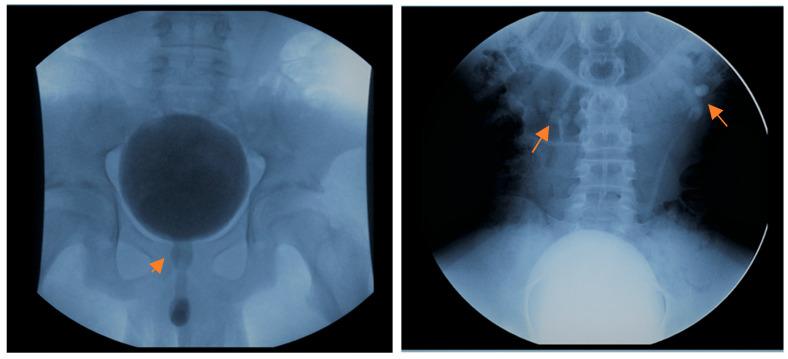
Voiding cystourethrogram in a 14-year-old with delayed diagnosis of posterior urethral valves: dilated, elongated posterior urethra below the bladder (left, arrowhead) and bilateral vesicoureteral reflux (right, arrows). From Kyriopoulos C, et al. Reports. 2026;9(1):76, Figure 2 (CC BY 4.0).[46]
Long-Term Renal Outcomes
Renal function is the main lifelong concern. In a Finnish series of 193 patients, 44 (22.8%) reached ESRD, the Kaplan-Meier lifetime risk was 28.5%, and no new ESRD event was observed after age 34 in that cohort; this observation does not set an age to stop renal surveillance.[8] In a multicenter cohort of 274 boys treated before 90 days of age, survival analysis estimated a 16% risk of renal replacement therapy by age 10, and the risk depended on first-year nadir creatinine: stratified by that nadir, the estimated risk of RRT by age 10 was 0% for a nadir below 0.4 mg/dL, 2% for 0.4-0.69 mg/dL, 27% for 0.7-0.99 mg/dL, and 100% for a nadir of 1.0 mg/dL or above.[16] Function continues to decline into adulthood.[6] The EAU 2026 guideline cites a systematic review estimating CKD in up to 32% and ESRD in 20% of boys with PUV, states that about 20% develop ESRD despite optimal treatment, and recommends (strong) using serum creatinine nadir as a prognostic marker (a nadir above 0.85 mg/dL predicts a poor prognosis) and lifelong monitoring of bladder and renal function[39]. It also gives a wider CKD estimate of up to 65% from a separate source.[39] A single-center 15-year review of 46 patients found CKD in 65% (30/46; stage 2 was the largest category, 12/30 or 40%) and ESRD requiring renal replacement therapy in 23% of those with CKD; creatinine nadir after valve ablation, oligohydramnios, and initiation of CIC were associated with CKD in univariable analyses.[40] Among 39 of 89 eligible men with complete adult data, followed a median of 22.7 years (median age 26 at last contact), 46.1% had ESRD (35.9% transplanted), 5.1% had CKD, and 48.7% retained normal GFR.[7] In 52 selected patients without prior dialysis or transplantation and with eGFR >20 mL/min/1.73 m² after age 1, median annualized eGFR decline was 2.6 mL/min/1.73 m²/year; both children (n = 35) and adults (n = 17) showed progressive loss.[6]
In a retrospective cohort of 52 selected patients, proteinuria and recurrent febrile UTIs were associated with faster eGFR decline; whether treating them changes that trajectory was not tested.[6] Proteinuria signals renal deterioration and is screened for routinely; glomerular and tubular markers both track with renal outcome.[9][10] RAS inhibition can slow but does not prevent progression to ESRD (see Renal Preservation).[9] Children who develop a pressure-relieving "pop-off" mechanism in utero or in infancy (patent urachus, calyceal rupture/urinoma, bladder diverticula, or unilateral high-grade VUR) may be renally protected: a systematic review and meta-analysis pooling 10 studies (896 participants) found significantly lower serum creatinine and a significantly lower risk of CKD in children with a pop-off mechanism (odds ratio 0.48, 95% CI 0.23-0.98), though heterogeneity across studies was high.[41] A historical pop-off mechanism on an adult's chart (for example, an old urinoma or unilateral reflux) is worth documenting, but should not reassure an individual about renal prognosis: pediatric pooled associations are heterogeneous, and another meta-analysis found no statistically significant reduction in ESRD.[41][47]
Valve Bladder Syndrome
The "valve bladder syndrome", coined by Mitchell in 1982, describes persistent, severely impaired bladder dynamics despite successful valve ablation.[11][12] The pathophysiology is a self-reinforcing triad of sustained bladder overdistention:[12]
- Polyuria from a nephrogenic concentrating defect
- Impaired bladder sensation
- Incomplete emptying with significant residual urine
These synergize to prevent bladder normalization, progressively reduce functional capacity, and drive bladder decompensation, upper-tract dilation, and further renal injury.[12] Among 39 men with complete adult follow-up data out of 89 childhood PUV patients, 15/39 (38%) had lower urinary tract dysfunction after a median 22.7 years.[7] Glassberg’s review describes varying degrees of bladder-compliance loss in the majority of patients after valve ablation.[11] The phenotype evolves with age: low compliance and detrusor overactivity dominate in infancy; later the bladder tends to become oversized with poor emptying (myogenic failure).[13] Secondary bladder-neck hypertrophy, residual valve tissue and urethral stricture can contribute to persistent obstruction after ablation; among 21 boys with before-and-after urodynamic assessments, five had high-pressure outlet obstruction (two residual valves, two bladder-neck obstruction and one stricture), including two with normal flow rates.[14][17]
Bladder Management
Bladder dysfunction is a major modifiable driver of renal deterioration, so bladder management is central to adult PUV care and escalates stepwise.
Step 1 — Behavioral and conservative measures
- Timed and double voiding are used to minimize residual urine.
- Nocturnal bladder emptying. Consider when polyuria and impaired sensation cause overnight overdistention despite adequate daytime emptying. Koff et al. reported improved hydronephrosis with overnight drainage or scheduled nocturnal emptying in selected patients with valve bladder syndrome.[12] In a randomized trial, 99 boys with persistent hydronephrosis after valve ablation completed 12-month follow-up (47 overnight drainage, 52 controls); both groups were offered timed voiding, anticholinergics and antibiotic prophylaxis. Overnight drainage improved hydronephrosis, reflux, bladder morphology and daytime continence, while febrile UTIs and renal-function measures did not differ significantly between groups.[49]
- Clean intermittent catheterization (CIC) is used for significant post-void residuals. The EAU 2026 guideline states that CIC has been shown to delay dialysis in progressive CKD and to improve ten-year graft survival in transplanted patients, and describes a catheterizable channel as an alternative when urethral CIC is not possible or not wanted.[39] Early CIC may counteract functional decline. In a series of 35 boys with bladder management from infancy, median differential GFR rose 7% in 14 boys continuing CIC at follow-up after three transplanted boys were excluded (similar to boys not on CIC) and fell 24% in the 2 boys who stopped CIC.[15] In a multicenter cohort, CIC was recommended for an estimated 26% of boys by age 10.[16] A redundant posterior urethra is described in some patients with PUV and can make urethral CIC technically difficult and painful; when the urethral route is not workable for this or other reasons, a Mitrofanoff catheterizable channel is an alternative, not a sign that catheterization itself should be abandoned.[44]
Step 2 — Pharmacotherapy
| Drug class | Agents | Indication / rationale | Notes |
|---|---|---|---|
| Antimuscarinics | Oxybutynin, solifenacin, tolterodine | Detrusor overactivity, poor compliance | Improve compliance and continence and can resolve secondary VUR; risk of precipitating myogenic failure, so PVR and urodynamics are monitored[17] |
| Alpha-1 blockers | Tamsulosin, doxazosin | Secondary bladder-neck obstruction / functional outlet resistance | Modest improvement in Qmax and emptying[14]. In a retrospective comparison of 179 patients (59 given tamsulosin for elevated PVR or persistent hydronephrosis after valve ablation, median age at start 2 years), tamsulosin use was associated with less progression to CIC (Cox regression HR 0.44, 95% CI 0.22-0.90, p = .025; median 52.6 months from tamsulosin initiation to CIC among those who progressed), but there was no difference in progression to dialysis or transplantation — tamsulosin may delay catheterization, but prevention was not established.[42] |
| Combination (antimuscarinic + alpha-blocker) | — | Storage + voiding dysfunction together | Pilot RCT after valve ablation showed the most consistent favorable urodynamic pattern (capacity, Pdet), though between-group differences were not significant[18] |
| β3-agonists | Selected adult OAB therapy | May be considered for bothersome storage symptoms after assessment of emptying and bladder safety | PUV-specific efficacy is not established; OAB and pediatric neurogenic-bladder indications should not be conflated with congenital non-neurogenic PUV |
The EAU 2026 guideline states that anticholinergics can improve bladder function in overactive bladders, that alpha-blockers can reduce residual urine when emptying is poor, and that early oxybutynin may improve bladder function (level 1b) without a demonstrated effect on renal function or UTI risk.[39] Anticholinergics are not benign here: in one urodynamics-guided series, 2 of 21 patients developed new myogenic failure requiring CIC after starting an antimuscarinic; close urodynamic monitoring is advised.[17]
Step 3 — Intravesical onabotulinumtoxinA
For refractory detrusor overactivity or poor compliance, intradetrusor onabotulinumtoxinA is a specialist option with limited PUV-specific evidence. In a preliminary series of 15 children, detrusor overactivity resolved in 7/11, and reflux resolved in 5/8 affected renal units; median compliance increased from 6 to 12.1 mL/cmH₂O[19]. Counsel about retention, potential CIC, infection and repeat treatment. The AUA/SUFU adult neurogenic LUTD recommendations provide adjacent safety guidance; PUV itself is not a neurogenic diagnosis.[20]
Step 4 — Bladder augmentation ± catheterizable channel
Augmentation cystoplasty (usually ileocystoplasty), with or without a Mitrofanoff continent catheterizable channel, is an option when a persistently unsafe bladder cannot be managed adequately with less invasive measures.[20][21]
- Indication. Capacity, compliance, or detrusor overactivity refractory to medications and botulinum toxin.[20][21]
- Channel evidence is separate from augmentation evidence. A 24-patient Mitrofanoff/CIC/overnight-drainage series reported improved hydronephrosis (mean combined renal-pelvis AP diameter −14.2 mm) and fewer poorly compliant bladders (75% to 28.6%). ESRD developed in 35% despite these improvements. This uncontrolled study cannot quantify renal protection versus alternative care, and does not test augmentation itself.[22]
- Burden. Bowel-incorporating reconstruction commits the patient to lifelong surveillance: metabolic acidosis, vitamin B12 deficiency (ileal segments), stones, mucus, perforation risk, and a small long-term malignancy risk. Document any prior gastric augmentation separately: in one retrospective PUV transplant cohort of 45 patients, malignancy developed in both patients with gastric augments (2/2), one fatal.[48] See Transitional Urology, augmentation surveillance and Bladder Augmentation.
- Approach. Laparoscopic / robot-assisted catheterizable channels have been described in small adult series.[23]
Renal Preservation
Renal preservation is the overriding lifelong goal and is co-managed with nephrology. The reconstructive urologist keeps the lower tract a safe, low-pressure reservoir and confirms that nephroprotective medical therapy is in place.
- RAS inhibition (ACE inhibitor / ARB) is the usual pharmacologic therapy for PUV patients with proteinuria. The dose is titrated to the maximum tolerated and continued as eGFR falls, and potassium and creatinine are monitored instead of stopping therapy reflexively.[9][24]
- SGLT2 inhibitors. Use adult CKD indications with nephrology, rather than prescribing for PUV alone. KDIGO 2024 recommends SGLT2 inhibitor treatment (grade 1A) for type 2 diabetes with CKD and eGFR ≥20, or for adults with CKD and eGFR ≥20 plus ACR ≥200 mg/g, or heart failure irrespective of albuminuria.[24] It suggests SGLT2 inhibitor treatment (grade 2B) at eGFR 20–45 with ACR below 200 mg/g.[24] A broad trial meta-analysis supports kidney benefit across studied subgroups, but there are no PUV-specific trials and these recommendations should not be extrapolated to children.[24][25]
- Proteinuria. Proteinuria is a modifiable predictor of decline; screen at least annually with urine ACR and intensify RAS / SGLT2 therapy when it appears.[6][24]
- Blood pressure. Hypertension is common and accelerates renal loss; treat to guideline targets.[24]
- Polyuria / concentrating defect. Assess urine volume, renal function, fluid needs and overnight emptying with nephrology. A 2005 study in 16 selected children found reduced urine output with desmopressin.[26] Desmopressin is not routine treatment for PUV-related polyuria. The oral tablet label contraindicates use with creatinine clearance below 50 mL/min or current/past hyponatremia; fluid and sodium precautions still apply.[38]
Renal Transplantation and Bladder Optimization
For the large minority who reach ESRD, transplantation is the treatment of choice, but the valve bladder follows the graft, and a hostile lower tract is what distinguishes PUV transplantation from transplantation for other causes.
- Long-term graft outcomes vary by comparison group. A registry study compared PUV (127 recipients), renal hypoplasia/dysplasia (245), and reflux nephropathy (727): 10-year graft survival was 70%, 76% and 70%, and 20-year survival 30%, 53% and 49%, respectively. After adjustment for age at transplant, graft source and HLA matching, PUV was associated with poorer graft survival (HR 1.65, 95% CI 1.15–2.38).[27]
- A separate matched study of 31 PUV and 31 non-urologic recipients found lower eGFR at 1–10 years and more UTIs (68% versus 3%) in PUV. In adjusted analysis, acute rejection was associated with advanced CKD.[28]
- The EAU 2026 guideline states that transplantation is safe and effective when bladder function is managed (level 3) and that graft deterioration is mainly related to lower urinary tract dysfunction.[39] In a retrospective cohort of 123 kidney transplants in 112 adults with congenital lower urinary tract malformations (including 49 PUV cases), graft survival did not differ for enterocystoplasty or urinary diversion versus native bladder with well-conducted bladder management over a mean 7.2-year follow-up; acute graft pyelonephritis was more frequent with enterocystoplasty and continent diversion.[29]
- Pre-transplant bladder optimization. Assess capacity, compliance and emptying, and establish a safe management plan before transplant. Augmentation need and timing require individualized multidisciplinary planning; the small cited transplant series does not compare before-versus-after timing.[30] A history-driven testing framework has been described for selecting the initial pretransplant studies: a child with recurrent UTI, a congenital uropathy, voiding complaints or dysfunction, or a defunctionalized bladder gets renal ultrasound plus VCUG, while a child without that history gets renal ultrasound plus PVR. In the source algorithm, severe reflux or hydronephrosis leads to urodynamic evaluation; bladder capacity <30% of expected for age leads to anticholinergic medication and reassessment, while incomplete emptying and urethral abnormalities have separate management branches.[45] An anuric child with no urologic history does not need additional bladder testing for anuria alone, but a history of PUV, neurogenic bladder, or complex uropathy may justify bladder cycling and anticholinergic treatment before transplant. Volitional emptying should not be assumed; it is confirmed with repeated low postvoid residuals and uroflowmetry, and pretransplant CIC can help demonstrate adherence. Where reconstruction is being planned, one broad target has been described as capacity above 75% of expected for age with filling or leak-point pressure below 40 cm H₂O, maintained with CIC no more often than every 3–4 hours; the authors describing this framework state that its specific thresholds are somewhat arbitrary and not based on strong clinical data, so present it as a starting point for individualized planning rather than a validated protocol.[45]
Sexual and Reproductive Outcomes
A systematic review of 11 studies (2,723 individuals) found that most males treated for PUV in childhood reach adulthood with preserved erectile and ejaculatory function.[32] The EAU 2026 guideline reports normal erectile function and fertility potential in long-term studies, with a higher risk of bilateral cryptorchidism, recurrent epididymitis and ESRD that can reduce fertility in individual patients.[39] A literature review of the PUV-cryptorchidism association found undescended testis in 12-17% of boys with PUV compared with 1-2% of the general population, a roughly 10-fold increase; the cause of the co-occurrence is uncertain.[43] Among 32 men assessed for sexual function in one adult series, none reported erectile dysfunction and 4/32 (12.5%) reported slow ejaculation.[7] Semen parameters are normal in roughly half of cohorts, with abnormalities clustering in those with renal impairment.[32] Paternity rates vary widely (6–58%) and are lower with renal dysfunction or urinary incontinence.[32] In Finnish data, 49% of 67 respondents had fathered children, similar to age-matched population rates, despite chronic renal failure in some.[33] In a Swedish follow-up of 19 men, the ability to father children depended on whether the man was uremic.[34] Lower urinary tract symptoms are common and may erode sexual self-efficacy, so they are addressed proactively during transition.[35]
Transition from Pediatric to Adult Care
The transition window is a vulnerable one: adolescents with PUV have an overwhelming desire to be "normal" and may disengage from follow-up just as their renal and bladder trajectories enter the high-risk pubertal period.[2][9]
Challenges
- Loss to follow-up driven by the drive for normalcy and the move away from a familiar pediatric team.[9]
- Lack of standardized transition protocols and transition coordinators across systems.
- Many adult urologists are unfamiliar with the nuances of congenital uropathy and reconstructed anatomy.[9][37]
What works
- Dedicated multidisciplinary clinics combining pediatric and adult urology, nephrology, and psychosocial support, with a transition coordinator.[2]
- Structured pathways and psychosocial-readiness assessment. Health literacy and family support are the primary predictors of successful transition.
- Pediatric clinic outcomes. In a retrospective before-and-after comparison of 196 children diagnosed before age 24 months (63 in a dedicated PUV clinic, 133 in earlier care), five-year CKD progression was 12% versus 27% and kidney replacement therapy was 3% versus 20%; primary diversion and nadir creatinine also differed between groups.[36]
Lifelong Surveillance
The intervals below are an illustrative stable-adult framework. Children, patients with changing renal function, and those with an unsafe bladder need individualized, often closer follow-up.[1]
| Domain | Frequency | Method |
|---|---|---|
| Renal function (eGFR, creatinine) | Every 6–12 months | Serum creatinine ± cystatin C[1][6] |
| Proteinuria | Every 6–12 months | Urine ACR (proteinuria is associated with faster eGFR decline)[6][10] |
| Bladder function | Annually | Uroflow, PVR and diary, with invasive UDS according to risk, phenotype and treatment decisions. A 28-boy comparison did not establish equivalence; the French pediatric protocol recommends repeated VUDS during follow-up[1][31] |
| Blood pressure | Every visit | Office ± ambulatory[24] |
| Renal imaging | Annually | Ultrasound (hydronephrosis, renal size)[1] |
| Metabolic monitoring (if augmented) | At least annual review, adjusted to segment and renal risk | Renal function, electrolytes/bicarbonate and B12 when ileal incorporation creates risk; blood gas when acid-base clarification is needed. Adult NLUTD guidance is adjacent evidence[20] |
| UTI surveillance | Ongoing | Culture if symptomatic; assess recurrent febrile UTIs for VUR and bladder dysfunction[1][6] |
| Sexual / reproductive health | Periodically | Symptom assessment, semen analysis if fertility desired[32] |
| Psychosocial / QoL | Periodically | Validated questionnaires[32] |
Key Principles
- PUV is a lifelong disease. Renal and bladder function frequently deteriorate at puberty and into adulthood; surveillance must continue across the life course.[1][9]
- Proteinuria and recurrent febrile UTIs track faster renal decline. Screen for and manage both.[6]
- Check for overnight overdistention when daytime management does not adequately protect the upper tracts; add nocturnal emptying when indicated.[12]
- Stepwise bladder management. Timed voiding or CIC address poor emptying; antimuscarinics with or without alpha-blockers address storage and outlet dysfunction; intradetrusor botulinum toxin is an option for refractory storage dysfunction.[12][17][18][19] Consider augmentation, with a catheterizable channel when needed, for a persistently unsafe reservoir after less invasive treatment.[1][20][21] In a 24-patient Mitrofanoff/CIC/overnight-drainage series, hydronephrosis and compliance improved but 35% developed ESRD.[22]
- Establish a safe bladder plan before transplantation; augmentation timing is individualized.[29][30]
- Discuss sexual function and fertility proactively. Outcomes vary, with reduced paternity associated with renal failure and incontinence.[32][33]
- Multidisciplinary follow-up. The favorable dedicated-clinic comparison is observational and confounded.[36]
See Also
- Transitional Urology, the parent hub: transition versus transfer, readiness tools, and augmentation surveillance.
- Neurogenic Bladder: overlapping adult NLUTD framework (AUA/SUFU 2021).
- Bladder Augmentation: an option for a persistently unsafe valve bladder after less invasive management fails[45].
- Catheterizable Channels: Mitrofanoff / Monti principles.
- Hypospadias & Epispadias: sibling lifelong-care congenital condition.
References
1. El-Ghoneimi A, Harper L, Pierucci UM, et al. "Management of Patients With Posterior Urethral Valves 'From the Fetus to Adolescence': French National Diagnostic and Care Protocol (NDCP)." Orphanet J Rare Dis. 2025;20(1):225. doi:10.1186/s13023-025-03712-5
2. Lopez AD, Kalaga I, Copp HL, Shaw NM, Hampson LA. "Transitional Urology: A Comprehensive Review of the Transitional Care Process." Nat Rev Urol. 2026. doi:10.1038/s41585-026-01152-9
3. Bomalaski MD, Anema JG, Coplen DE, et al. "Delayed Presentation of Posterior Urethral Valves: A Not So Benign Condition." J Urol. 1999;162(6):2130-2132. doi:10.1016/S0022-5347(05)68140-2
4. Mueller SC, Marshall FF. "Spectrum of Unrecognized Posterior Urethral Valves in the Adult." Urology. 1983;22(2):139-142. doi:10.1016/0090-4295(83)90495-8
5. Saraf PG, Valvo JR, Frank IN. "Congenital Posterior Urethral Valves in an Adult." Urology. 1984;23(1):55-57. doi:10.1016/0090-4295(84)90177-8
6. Huang VW, Behairy M, Abelson B, et al. "Kidney Disease Progression in Pediatric and Adult Posterior Urethral Valves (PUV) Patients." Pediatr Nephrol. 2024;39(3):829-835. doi:10.1007/s00467-023-06128-0
7. Çetin B, Dönmez Mİ, Erdem S, Ziylan O, Oktar T. "Renal, Bladder and Sexual Outcomes in Adult Men With History of Posterior Urethral Valves Treated in Childhood." Urology. 2021;153:301-306. doi:10.1016/j.urology.2020.11.002
8. Heikkilä J, Holmberg C, Kyllönen L, Rintala R, Taskinen S. "Long-Term Risk of End Stage Renal Disease in Patients With Posterior Urethral Valves." J Urol. 2011;186(6):2392-2396. doi:10.1016/j.juro.2011.07.109
9. Woodhouse CR, Neild GH, Yu RN, Bauer S. "Adult Care of Children From Pediatric Urology." J Urol. 2012;187(4):1164-1171. doi:10.1016/j.juro.2011.12.011
10. Heikkilä J, Jahnukainen T, Holmberg C, Taskinen S. "Association of Renal Glomerular and Tubular Function With Renal Outcome in Patients With Posterior Urethral Valves." Urology. 2021;153:285-290. doi:10.1016/j.urology.2020.11.045
11. Glassberg KI. "The Valve Bladder Syndrome: 20 Years Later." J Urol. 2001;166(4):1406-1414. doi:10.1016/s0022-5347(05)65796-5
12. Koff SA, Mutabagani KH, Jayanthi VR. "The Valve Bladder Syndrome: Pathophysiology and Treatment With Nocturnal Bladder Emptying." J Urol. 2002;167(1):291-297. doi:10.1016/s0022-5347(05)65453-5
13. Taskinen S, Heikkilä J, Rintala R. "Effects of Posterior Urethral Valves on Long-Term Bladder and Sexual Function." Nat Rev Urol. 2012;9(12):699-706. doi:10.1038/nrurol.2012.196
14. Androulakakis PA, Karamanolakis DK, Tsahouridis G, Stefanidis AA, Palaeodimos I. "Myogenic Bladder Decompensation in Boys With a History of Posterior Urethral Valves Is Caused by Secondary Bladder Neck Obstruction?" BJU Int. 2005;96(1):140-143. doi:10.1111/j.1464-410X.2005.05583.x
15. Holmdahl G, Sillen U, Hellström AL, Sixt R, Sölsnes E. "Does Treatment With Clean Intermittent Catheterization in Boys With Posterior Urethral Valves Affect Bladder and Renal Function?" J Urol. 2003;170(4 Pt 2):1681-1685. doi:10.1097/01.ju.0000084142.71123.b5
16. McLeod DJ, Szymanski KM, Gong E, et al. "Renal Replacement Therapy and Intermittent Catheterization Risk in Posterior Urethral Valves." Pediatrics. 2019;143(3):e20182656. doi:10.1542/peds.2018-2656
17. Kim YH, Horowitz M, Combs AJ, et al. "Management of Posterior Urethral Valves on the Basis of Urodynamic Findings." J Urol. 1997;158(3 Pt 2):1011-1016. doi:10.1097/00005392-199709000-00085
18. Singhai P, Malik MA, Mahajan JK. "Effect of Anticholinergics vs. Alpha-1 Blockers vs. Combination Therapy on Bladder Function in Patients With Posterior Urethral Valve After Transurethral Fulguration: A Pilot Randomized Controlled Trial." Pediatr Surg Int. 2026;42(1):226. doi:10.1007/s00383-026-06467-7
19. Mohan Kunnath S, Solomon E, Mishra P, et al. "Intravesical Botulinum Toxin Injection for Treating Detrusor Overactivity and Poor Compliance in Posterior Urethral Valves — A Preliminary Experience." Neurourol Urodyn. 2025;44(4):760-767. doi:10.1002/nau.70039
20. Ginsberg DA, Boone TB, Cameron AP, et al. "The AUA/SUFU Guideline on Adult Neurogenic Lower Urinary Tract Dysfunction: Treatment and Follow-Up." J Urol. 2021;206(5):1106-1113. doi:10.1097/JU.0000000000002239
21. Cheng PJ, Myers JB. "Augmentation Cystoplasty in the Patient With Neurogenic Bladder." World J Urol. 2020;38(12):3035-3046. doi:10.1007/s00345-019-02919-z
22. King T, Coleman R, Parashar K. "Mitrofanoff for Valve Bladder Syndrome: Effect on Urinary Tract and Renal Function." J Urol. 2014;191(5 Suppl):1517-1522. doi:10.1016/j.juro.2013.09.008
23. Rey D, Helou E, Oderda M, et al. "Laparoscopic and Robot-Assisted Continent Urinary Diversions (Mitrofanoff and Yang-Monti Conduits) in a Consecutive Series of 15 Adult Patients: The Saint Augustin Technique." BJU Int. 2013;112(7):953-958. doi:10.1111/bju.12257
24. Kidney Disease: Improving Global Outcomes (KDIGO) CKD Work Group. "KDIGO 2024 Clinical Practice Guideline for the Evaluation and Management of Chronic Kidney Disease." Kidney Int. 2024;105(4S):S117-S314. doi:10.1016/j.kint.2023.10.018
25. Neuen BL, Fletcher RA, Anker SD, et al. "SGLT2 Inhibitors and Kidney Outcomes by Glomerular Filtration Rate and Albuminuria." JAMA. 2026;335(3):233-244. doi:10.1001/jama.2025.20834
26. Naghizadeh S, Kefi A, Dogan HS, et al. "Effectiveness of Oral Desmopressin Therapy in Posterior Urethral Valve Patients With Polyuria and Detection of Factors Affecting the Therapy." Eur Urol. 2005;48(5):819-825. doi:10.1016/j.eururo.2005.05.019
27. McKay AM, Kim S, Kennedy SE. "Long-Term Outcome of Kidney Transplantation in Patients With Congenital Anomalies of the Kidney and Urinary Tract." Pediatr Nephrol. 2019;34(11):2409-2415. doi:10.1007/s00467-019-04300-z
28. Rickard M, Chua ME, Robinson CH, et al. "Post-Transplant Kidney Function Decline in Children With Posterior Urethral Valves Versus Non-Urologic Etiologies: Roles of Catheterization, Infection, and Rejection." Pediatr Nephrol. 2026. doi:10.1007/s00467-026-07361-z
29. Marchal S, Kalfa N, Iborra F, et al. "Long-Term Outcome of Renal Transplantation in Patients With Congenital Lower Urinary Tract Malformations: A Multicenter Study." Transplantation. 2020;104(1):165-171. doi:10.1097/TP.0000000000002746
30. DeFoor W, Tackett L, Minevich E, et al. "Successful Renal Transplantation in Children With Posterior Urethral Valves." J Urol. 2003;170(6 Pt 1):2402-2404. doi:10.1097/01.ju.0000089773.40598.b3
31. Capitanucci ML, Marciano A, Zaccara A, et al. "Long-Term Bladder Function Followup in Boys With Posterior Urethral Valves: Comparison of Noninvasive vs Invasive Urodynamic Studies." J Urol. 2012;188(3):953-957. doi:10.1016/j.juro.2012.04.121
32. Gnech M, Pakkasjärvi N, 't Hoen L, et al. "Long-Term Sexual Function, Fertility, and Quality of Life After Childhood Treatment for Posterior Urethral Valves: A Systematic Review of Clinical Outcomes." J Sex Med. 2026;23(3):qdag035. doi:10.1093/jsxmed/qdag035
33. Taskinen S, Heikkilä J, Santtila P, Rintala R. "Posterior Urethral Valves and Adult Sexual Function." BJU Int. 2012;110(8 Pt B):E392-E396. doi:10.1111/j.1464-410X.2012.11091.x
34. Holmdahl G, Sillén U. "Boys With Posterior Urethral Valves: Outcome Concerning Renal Function, Bladder Function and Paternity at Ages 31 to 44 Years." J Urol. 2005;174(3):1031-1034. doi:10.1097/01.ju.0000170233.87210.4f
35. Zöhrer PI, Vauth F, Jaekel AK, Rösch WH, Hofmann A. "Navigating Life With Posterior Urethral Valves — Sexual Health and Lower Urinary Tract Symptoms." J Clin Med. 2024;13(15):4380. doi:10.3390/jcm13154380
36. Rickard M, Lorenzo AJ, Robinson C, et al. "Impact of a Standardized Care Pathway and a Dedicated Multidisciplinary Posterior Urethral Valve Clinic on 5-Year Kidney and Bladder Outcomes." Pediatr Nephrol. 2025. doi:10.1007/s00467-025-06864-5
37. Wiener JS, Huck N, Blais AS, et al. "Challenges in Pediatric Urologic Practice: A Lifelong View." World J Urol. 2021;39(4):981-991. doi:10.1007/s00345-020-03203-1
38. DailyMed. "Desmopressin Acetate Tablets: Prescribing Information." Contraindications and warnings. Label.
39. European Association of Urology. EAU Guidelines on Paediatric Urology: Congenital Lower Urinary Tract Obstruction, Posterior Urethral Valves (section 21). 2026 limited update, March 2026. Guideline.
40. Bain A, Lavoie C, Rodriguez-Lopez S, Kiddoo D. "Renal Outcomes of Children Born With Posterior Urethral Valves at a Tertiary Center: A 15-Year Retrospective Review." Can Urol Assoc J. 2023;17(4):111-116. doi:10.5489/cuaj.8102
41. Arredondo Montero J, Pérez Riveros BP, Rico Jiménez M, Bueso Asfura OE, Martín-Calvo N. "Pop-Off Mechanisms as Renoprotective Mediators in Children With Posterior Urethral Valves: A Systematic Review and Meta-Analysis." J Pediatr Urol. 2024;20(1):57-66. doi:10.1016/j.jpurol.2023.10.003
42. Kim JK, Khondker A, Chua ME, et al. "Assessing the Utility of Tamsulosin in Delaying Progression to Clean Intermittent Catheterization and End-Stage Renal Disease in Patients With Posterior Urethral Valves: Are We Postponing the Inevitable?" Urology. 2023;179:151-157. doi:10.1016/j.urology.2023.05.034
43. Wong J, Punwani V, Lai C, Chia J, Hutson JM. "Why Do Undescended Testes and Posterior Urethral Valve Occur Together?" Pediatr Surg Int. 2016;32(5):509-514. doi:10.1007/s00383-016-3883-4
44. Lopez Pereira P, Martinez Urrutia MJ, Espinosa L, Jaureguizar E. "Long-Term Consequences of Posterior Urethral Valves." J Pediatr Urol. 2013;9(5):590-596. doi:10.1016/j.jpurol.2013.06.007
45. Lorenzo AJ, Peters CA. Urologic Considerations in Pediatric Renal Transplantation. In: Partin AW, Dmochowski RR, Kavoussi LR, Peters CA, eds. Campbell-Walsh-Wein Urology. 13th ed. Elsevier; 2025:1279-1288.
46. Kyriopoulos C, Papakonstantinou A, Fragkiadis E, Moulavasilis N, Mitsos P. "Delayed Diagnosis of Posterior Urethral Valves in a 14-Year-Old Adolescent." Reports. 2026;9(1):76. doi:10.3390/reports9010076
47. Khondker A, Kim K, Tadayon Najafabadi B, et al. "Posterior urethral valves, pressure pop-offs, and kidney function: systematic review and meta-analysis." World J Urol. 2023;41(7):1803-1811. doi:10.1007/s00345-023-04451-7
48. Silverii H, Merguerian P, Fernandez N, Smith J, Shnorhavorian M, Ahn J. "Posterior urethral valves and kidney transplantation: Identifying opportunities for improvement." J Pediatr Urol. 2024;20(Suppl 1):S58-S65. doi:10.1016/j.jpurol.2024.06.022
49. Elkashef A, Abdelhalim A, Dawaba MS, Hafez AT. "Effect of overnight bladder drainage on posterior urethral valve sequelae: A randomized controlled trial." J Pediatr Urol. 2025;21(2):528-531. doi:10.1016/j.jpurol.2024.11.006