Female Urethroplasty
Female urethral reconstruction addresses stricture, diverticulum, prolapse, post-MUS-erosion scarring, and complete urethral loss or obliteration. No dorsal or ventral approach is universally preferred. The choice between oral-mucosal graft and vaginal-flap reconstruction depends on stricture anatomy, tissue quality and surgeon experience.[1][2]
The AUA 2023 amendment states that surgeons may reconstruct female strictures with oral mucosal grafts, vaginal flaps or a combination , and that urethroplasty should be offered because endoscopic treatment has low efficacy.[1] EAU 2026 recommends dilation to 24–41 Fr initially , repeat dilation with planned weekly intermittent self-dilation using a 16–18 Fr catheter or planned repeat dilation at first recurrence , and urethroplasty at second recurrence when self-dilation is unsuitable or definitive treatment is desired .[2] It leaves the technique to surgeon experience, graft or flap availability and the quality of the ventral versus dorsal urethra.[2] The table below lists reported options by scenario.
Decision Framework — Choosing a Female Urethroplasty
| Clinical Scenario | Reconstructive option | Alternative(s) | Avoid / limitations |
|---|---|---|---|
| Distal / meatal stricture (short, isolated) | EAU 2026 recommends meatotomy/meatoplasty for short meatal strictures [2] | Distal urethrectomy + advancement meatoplasty for selected distal-segment disease after defining proximal extent; dorsal onlay graft (BMG, labial, or lingual mucosa) when augmentation is needed | Repeated dilation with curative intent |
| Mid-urethral stricture, healthy vaginal tissue | Vaginal wall flap (ventral onlay or inlay) ± Martius reinforcement | Dorsal onlay graft | — |
| Mid-urethral stricture, atrophic vagina | Oral mucosal graft: dorsal onlay or ventral onlay, selected by local tissue quality and surgeon experience[2][9] | Buccal or lingual mucosa according to donor-site suitability | Vaginal flap / graft from atrophic tissue |
| Pan-urethral or long-segment stricture | Define the full extent and local tissue quality before choosing a graft/flap route; dorsal onlay graft extended through the mapped diseased segment is one option[2] | Ventral onlay graft when ventral tissue is suitable; comparative female data do not establish a superior route[9] | Repeated dilation with curative intent |
| LS-related stricture | Oral-mucosal graft selected by stricture extent and viable urethral tissue; dorsal onlay BMG is one option[2][14] | Ventral oral-graft access may be considered when ventral tissue is suitable; female LS-specific comparative evidence is lacking | Avoid diseased vaginal or labial donor tissue; the broader genital-tissue caution is based on expert extrapolation[14] |
| Prior MUS erosion / scarred periurethral bed | Distinguish exposed mesh from a healed scar and assess the urethral defect and continence; a four-woman series of erosion-related strictures described partial mesh resection, urethral-edge debridement and primary repair[12] | For a residual stricture, ventral onlay BMG with Martius reinforcement was described in 2 women with prior synthetic MUS[13]; dorsal BMG is another tissue-dependent option[2] | A scarred vaginal donor bed limits flap use[2]; recurrent SUI after mesh resection occurred in 2/4 women at 16 months in the primary-repair series[12] |
| Complete urethral loss / obliteration | Vaginal-wall tubularization, with continence surgery assessed individually (pubovaginal sling was used in most patients in one mixed urethral/vesical-neck series)[10] | Bladder wall flap (Tanagho or Nayyar) | — |
| Near- or completely-obliterative stricture, urethral plate salvageable | Double-face oral mucosa inlay (posterior and anterior grafts) — selected reports | — | Routine use in place of standard onlay grafting |
| Bladder neck obliteration (post-PFUI) | Bladder flap urethroplasty (anterior or posterior) | Nayyar novel anterior bladder tube | Repeated endoscopic procedures |
| Failed prior urethroplasty | Repeat urethroplasty using a graft or flap selected by available tissue and urethral anatomy[2]; BMG salvage after vaginal-flap recurrence was reported in 2 women[11] | Vaginal flap (if tissue healthy); alternative graft source | Further dilation |
| First presentation, mild symptoms | Trial of dilation after confirming an anatomical stricture | Discuss urethroplasty or intermittent self-dilation according to goals | Treating nonspecific LUTS without confirmed stricture |
EAU 2026 describes pelvic examination to assess prolapse, masses, scars, vulvar dermatoses and atrophy; it recommends flow rate, post-void residual and voiding cystourethrogram or videourodynamics in all women with refractory lower urinary tract symptoms .[2] For a mid- or proximal-urethral stricture, assessing continence before repair is worthwhile, because the stricture itself may be helping maintain continence. A stress cystogram or videourodynamics can determine whether continence is maintained despite an open bladder neck; when it is, relieving the obstruction may unmask incontinence that needs further treatment, a possibility to discuss with the patient beforehand.[3]
For augmentation grafting, the dorsal urethrotomy is typically extended about 5 mm beyond each end of the stricture, and passage of a 30-Fr Hegar dilator under its own weight has been described as a check of adequate caliber. Graft width is planned to combine with native urethral caliber for an approximately 30-Fr lumen, allowing for about 20% graft contraction. For strictures narrower than 7 Fr, a double-faced or tubularized graft/flap approach has been described.[4]
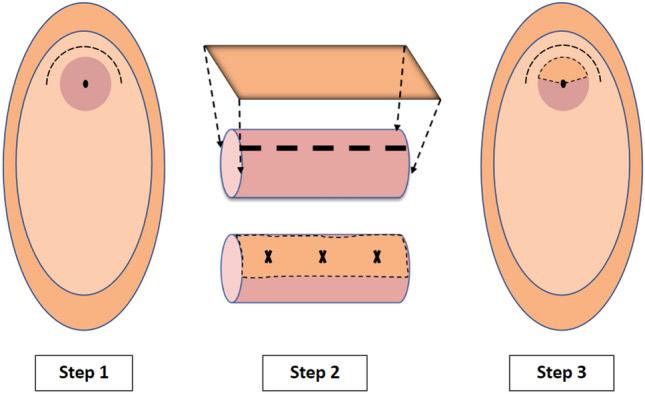
Dorsal onlay buccal mucosal graft female urethroplasty: Step 1, dorsal inverted-U incision around the meatus (10 to 2 o'clock) and dissection from dorsal attachments, preserving the lateral pubourethral ligaments and dorsal clitoral cavernosal tissue; Step 2, 12-o'clock dorsal urethrotomy and graft secured with PDS; Step 3, vaginal incision closed and meatus reapproximated to surrounding vaginal and vestibular epithelium. In the reported protocol, a capped 14-Fr urethral Foley remained for 2 weeks while an 18-Fr suprapubic catheter drained. From Higgins MM, et al. Int Urol Nephrol. 2023;55(5):1149-1154, Fig. 1 (CC BY 4.0).[7]
For a near- or completely-obliterative stricture with a salvageable urethral plate, a single-stage double-face oral mucosa inlay has been reported: a posterior (6 o'clock) inlay graft is placed first, and a second, anterior-wall inlay graft is placed after rotating the lumen (using a nasal speculum) to expose it. This has been described for strictures permitting only guidewire passage, below 7 Fr, or complete obliteration with suprapubic-catheter dependence. The original technical report described a single case.[5][6] In a two-centre retrospective series of 42 female urethroplasties (mean follow-up 27 months for the full cohort), 8 were double-face repairs and 7 of 8 met the study’s reported success endpoint; one distal double-face repair required further treatment.[8] It remains a selected option rather than a routine standard, distinct from Palminteri's earlier male perineal double-BMG operation.[5]
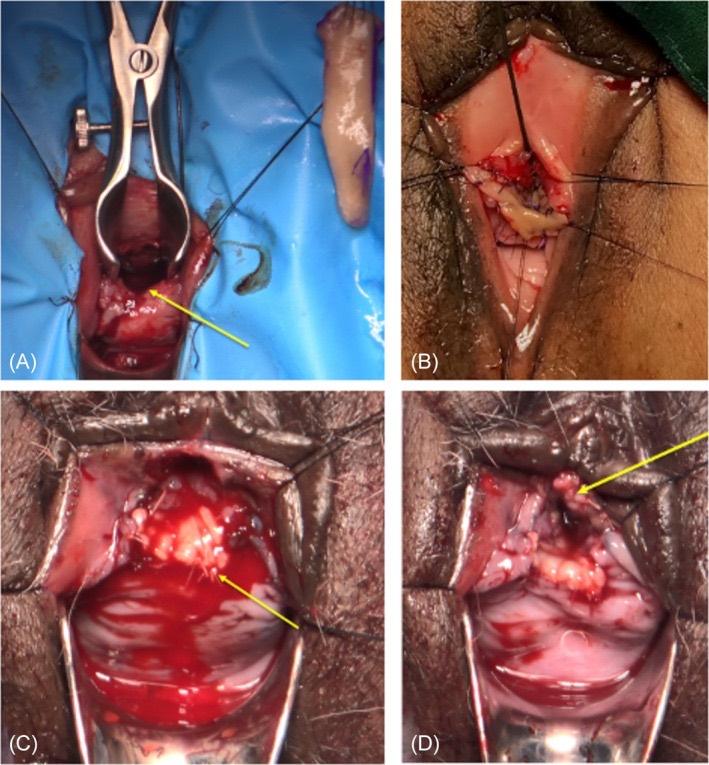
Ventral inlay and double-face female urethroplasty: (A) ventral urethrotomy (yellow arrow) with the buccal mucosal graft prepared for parachuting into it; (B) graft inlaid into the ventral urethra, with sutures at the lateral borders of the urethrotomy and the metal edge anteriorly; (C) double-face technique, ventral inlay component (graft marked in yellow); (D) double-face technique, completed dorsal inlay graft (marked in yellow). From Bain M, et al. BJUI Compass. 2025;6(5):e70024, Figure 3 (CC BY 4.0).[8]
Technique Database
| Technique | Best For |
|---|---|
| Endoscopic / Minimally Invasive | |
| Female DVIU and Urethral Dilation | Dilation for selected confirmed strictures; female DVIU evidence is limited |
| Distal Urethrectomy + Meatal Advancement | |
| Distal Urethrectomy with Advancement Meatoplasty | Short distal / meatal stricture |
| Flap Urethroplasty | |
| Blandy U-Flap Vaginal Flap Urethroplasty | Mid-urethral stricture, healthy vagina |
| Lateral-Based Anterior Vaginal Wall Flap | Mid / distal stricture; preserves orthotopic meatus |
| Anterior Vaginal Wall Mucosal Inlay (Önol) | Mid-urethral stricture; pedicled anterior vaginal-wall mucosal inlay |
| Dorsal Vaginal Flap Urethroplasty | Dorsal augmentation when oral mucosa unavailable |
| Labia Minora Pedicled Flap | Selected reconstruction with healthy labial tissue; avoid diseased donor tissue |
| Bladder Wall Flap Urethroplasty | Total urethral loss / obliterative bladder-neck contracture |
| Free Graft Urethroplasty | |
| Female Dorsal Onlay Urethroplasty | Dorsal graft option selected by anatomy and tissue quality |
| Female Ventral Onlay BMG Urethroplasty | Mid-urethral stricture; meatus preservation; requires vaginal dissection |
| Female Ventral Inlay BMG Urethroplasty | Vaginal-sparing graft option in selected anatomy |
| Female Dorsal Inlay BMG Urethroplasty | Female urethral stricture; transurethral inlay approach |
| Circular (Circumferential) BMG | Severe distal circumferential stricture (salvage) |
| Combined / Hybrid Techniques | |
| Combined Vaginal Flap + BMG | Complex stricture; one tissue source insufficient |
| Staged BMG Urethroplasty (Female) | Salvage for obliterative disease (rarely needed) |
| Urethral Loss / Obliteration Repair | |
| Primary End-to-End Anastomosis (Female) | Acute female PFUI; short obliterative defect |
| Vaginal Wall Tubularization Urethroplasty | Total / near-total urethral loss |
| Other Female Reconstructive Procedures | |
| Urethral Diverticulum Repair | Symptomatic urethral diverticulum |
| Urethral Prolapse Repair | Refractory / thrombosed urethral prolapse |
References
1. Wessells H, Morey A, Souter L, et al. Urethral stricture disease guideline amendment (2023). J Urol. 2023;210:64–71. doi:10.1097/JU.0000000000003482.
2. European Association of Urology. Urethral Strictures: Disease Management in Females. 2026. Official guideline.
3. Lec P, Nitti VW. Female urethral reconstruction. In: Smith JA Jr, Dmochowski RR, Thomas JC, Preminger GM, eds. Hinman's Atlas of Urologic Surgery. 5th ed. Elsevier; 2025:686.
4. Nayyar R, Kumar P, Uppal Nayyar B. Dorsal (anterior) onlay urethroplasty for female urethral stricture. In: Khattar N, Nayyar R, Panda A, eds. Female Bladder Outlet Obstruction and Urethral Reconstruction. Springer; 2021:162-166.
5. Joshi PM, Kulkarni SB. A new technique of double-face buccal graft urethroplasty for female urethral strictures. Turk J Urol. 2020;46(2):165-168. doi:10.5152/tud.2019.19228.
6. Harrison W, Joshi S, Desai D. Female double-face oral mucosa urethroplasty. In: Joshi PM, Aubé-Peterkin M, Kulkarni SB, Datar G, eds. Surgical Atlas of Urethroplasty. Springer; 2024:36-39.
7. Higgins MM, Wengryn D, Koslov D, Oliver J, Flynn BJ. Female urethroplasty with dorsal onlay buccal mucosal graft: a single institution experience. Int Urol Nephrol. 2023;55(5):1149-1154. doi:10.1007/s11255-023-03520-5.
8. Bain M, Gomez Zapata DE, Ravichandran K, et al. Female urethral stricture: a multi-centre experience and lessons learnt. BJUI Compass. 2025;6(5):e70024. doi:10.1002/bco2.70024.
9. Ortac M, Ozervarli MF, Ergul RB, et al. "Comparing ventral and dorsal oral mucosal graft urethroplasty in female urethral stricture: a systematic review and meta-analysis." World J Urol. 2025;43(1):397. doi:10.1007/s00345-025-05773-4
10. Blaivas JG, Heritz DM. "Vaginal flap reconstruction of the urethra and vesical neck in women: a report of 49 cases." J Urol. 1996;155(3):1014-1017. doi:10.1016/S0022-5347(01)66372-9
11. Blaivas JG, Santos JA, Tsui JF, et al. "Management of Urethral Stricture in Women." J Urol. 2012;188(5):1778–1782. doi:10.1016/j.juro.2012.07.042.
12. Waterloos M, et al. "Female Urethroplasty: Outcomes of Different Techniques in a Single Center." J Clin Med. 2021;10(17):3950. doi:10.3390/jcm10173950
13. Önol FF, et al. "Techniques and Results of Urethroplasty for Female Urethral Strictures: Our Experience with 17 Patients." Urology. 2011;77(6):1318-1324. doi:10.1016/j.urology.2011.01.017
14. Waterloos M, Verla W. "Female Urethroplasty: A Practical Guide Emphasizing Diagnosis and Surgical Treatment of Female Urethral Stricture Disease." Biomed Res Int. 2019;2019:6715257. doi:10.1155/2019/6715257