Urethrectomy
Urethrectomy is partial or total removal of the urethra. The reconstructive surgeon's role is to define the extent of resection, protect viable tissues and plan urinary diversion or genital reconstruction with the oncologic team.
Indications
At Radical Cystectomy
The 2024 AUA/ASCO/SUO guideline on non-metastatic muscle-invasive bladder cancer states in the discussion of Statement 11 (a Clinical Principle) that urethrectomy (immediate or delayed) should be performed in two situations. The first is high-grade cancer at the apical urethral margin after prostatectomy, assessed by frozen section or final pathology. The second is women not undergoing neobladder reconstruction. In patients receiving an orthotopic diversion, clinicians must verify a negative urethral margin (Statement 14, Clinical Principle). Following cystectomy with a retained urethra, the urethral remnant is monitored for recurrence (Statement 32, Expert Opinion). In women, the discussion reports urethral tumor involvement in about 12% of patients undergoing cystectomy and identifies involvement of the bladder neck, posterior bladder base or anterior vaginal wall as an important risk factor. It describes intraoperative frozen section of the proximal urethra as a reliable way to confirm that a woman is a candidate for orthotopic diversion.[1]
The EAU guideline on muscle-invasive bladder cancer (2026) makes a strong recommendation against an orthotopic bladder substitute when an invasive tumor is in the urethra or at the level of urethral dissection. A positive preoperative prostatic urethral biopsy alone should not deny a neobladder in men. Frozen section of the distal urethral stump decides, and it can be omitted after a negative preoperative biopsy (both strong). In women, the bladder neck and urethral margin are assessed histologically before or at cystectomy (strong). Concomitant urethral malignancy has been reported in 12% to 16% of women undergoing cystectomy, and a bladder-neck primary correlates strongly with it.[22]
NCCN Bladder Cancer Version 3.2026 describes prostatic-duct CIS and a positive urethral margin as relative contraindications to urethral drainage. Its wording differs from the AUA requirement to verify a negative urethral margin before orthotopic diversion.[26][1]
Ahlering and Skinner described the following historical indications in a 174-patient series. They are not all automatic contemporary indications for total urethrectomy:[2]
- Clinically overt urethral involvement.
- Prostatic stromal invasion.
- CIS of the prostatic urethra.
- Bloody urethral discharge after cystectomy.
Zabbo and Montie listed multifocal tumors, concurrent upper-tract tumors, diffuse CIS, trigone or prostatic urethral involvement and a positive urethral frozen section as indications for prophylactic urethrectomy.[3] Contemporary series report a 1% to 17% risk of cancer in the retained urethra, mostly within 2 years of surgery.[1] A systematic review cited by EAU found new urethral tumors after cystectomy in 4.4% (range 1.3% to 13.7%).[22] Risk factors were malignancy in the prostatic urethra or prostate in men and at the bladder neck in women, and orthotopic neobladder was associated with a lower risk (OR 0.44).[22]
A retrospective review of 211 men treated with radical cystectomy for MIBC found pathologic prostatic stromal involvement in 46 (22%).[23] Reported rates were 18% at cT2, 23% at cT3 and 48% at cT4; 17 of 34 men with preoperatively identified urethral involvement also had stromal involvement.[23] In this retrospective cohort, prostatic stromal involvement was not synonymous with urethral involvement.[23] At cystectomy, an invasive urethral tumor or high-grade cancer at the apical urethral margin warrants urethrectomy; the latter can be performed immediately or after final pathology.[1][22]
Concomitant male urethrectomy at the index cystectomy is uncommon in practice, because a negative urethral margin is achieved in the large majority of cases; high-grade cancer identified at the apical urethral margin only on final pathology warrants delayed urethrectomy.[1]
Primary Urethral Carcinoma
Resection depends on histology, location, stage and the ability to achieve negative margins. The EAU guideline recommends distal urethrectomy as an alternative to penile amputation for localized distal urethral tumors when negative margins can be achieved intraoperatively (Weak); for planned penile preservation, it recommends complete circumferential assessment of the proximal urethral margin (Strong). In women, EAU strongly recommends radical urethrectomy unless organ-preservation criteria are met and weakly recommends urethra-sparing surgery for distal tumors when negative margins can be achieved intraoperatively. For locally advanced squamous cell carcinoma, EAU weakly recommends definitive radiotherapy with radiosensitizing chemotherapy for genital preservation. It strongly recommends multidisciplinary discussion of locally advanced urethral carcinoma and weakly recommends histology-specific perioperative treatment, following its MIBC guidance for urothelial carcinoma. A stage-only table cannot prescribe the same chemoradiation strategy for every histology.[21]
For a malignant stricture-like lesion of the bulbar or penile urethra under 2 cm and clinically confined to the corpus spongiosum (T2), segmental urethrectomy with primary re-anastomosis or a neourethra can be curative rather than requiring total urethrectomy; a longer segment can still be excised but usually needs flap or graft reconstruction. MRI helps distinguish T2 (spongiosum-confined) from T3 (corporal) disease to plan the margin, and an organ-sparing approach is an option in selected low-grade, distal tumors. This segmental, margin-driven approach is a distinct clinical scenario from the total urethrectomy performed at or after cystectomy above.[24]
NCCN lists distal urethrectomy or partial penectomy for T2 pendulous tumors and urethrectomy with or without cystoprostatectomy for T2 bulbar tumors (category 2A). These options depend on tumor location; NCCN does not supply a 2-cm cutoff for segmental reconstruction.[26]
Surgical Approaches — Male
Prepubic Approach (workhorse)
A prepubic approach permits urethrectomy during cystoprostatectomy without a separate perineal exposure. The urethra and associated spongiosal tissue are mobilized along the corporal surface and delivered with the planned specimen. Preserve tissue planes appropriate to tumor extent; an en-bloc operation must not first divide the specimen in a way that defeats its oncologic purpose. A 180-patient retrospective series reported a mean 17-minute additional operative time.[4]
Hiebl urethral-stripping modification. Hiebl described a modification for difficult bulbar dissection in 21 patients. After periurethral mobilization, the urethra is cannulated with an 18 Fr catheter, sutured distally and stripped free. Blind stripping is avoided where tumor extent requires controlled en bloc margins.[5]
Prepubic versus perineal comparative outcomes (Elshal 2011, modified Clavien):[6]
| Metric | Prepubic | Perineal | p |
|---|---|---|---|
| Operative time | 174 min | 209 min | 0.003 |
| Hospital stay | 14.5 d | 17.6 d | 0.047 |
| Grade 4–5 events among reported complications | 2/21 events (9.5%) | 7/25 events (28%) | 0.033 as reported[6] |
| Added OR time vs cystectomy alone | ~17 min (15–25)[4] | Not reported; the total operation was about 35 min longer than prepubic | — |
| Repositioning to lithotomy | No | Yes | — |
Perineal Approach (traditional)
- Lithotomy positioning.
- Midline perineal incision; dissect through subcutaneous tissue to the bulbospongiosus muscle.
- Incise the bulbospongiosus muscle longitudinally at the midline and separate from corpus spongiosum.
- Circumferentially detach the urethra from the corporal bodies; mobilize from the penoscrotal angle to the urogenital diaphragm.
- For the penile urethra, circumferential subcoronal incision approximately 0.5 cm below the glans allows degloving along Buck's fascia.
- Mobilize the urethra circumferentially from the bulb toward the base of the glans for complete excision; at cystectomy, retain an en bloc specimen.[31] Verla describes perineal penile invagination as an alternative exposure for stricture urethroplasty, not as a step following subcoronal degloving.[7]
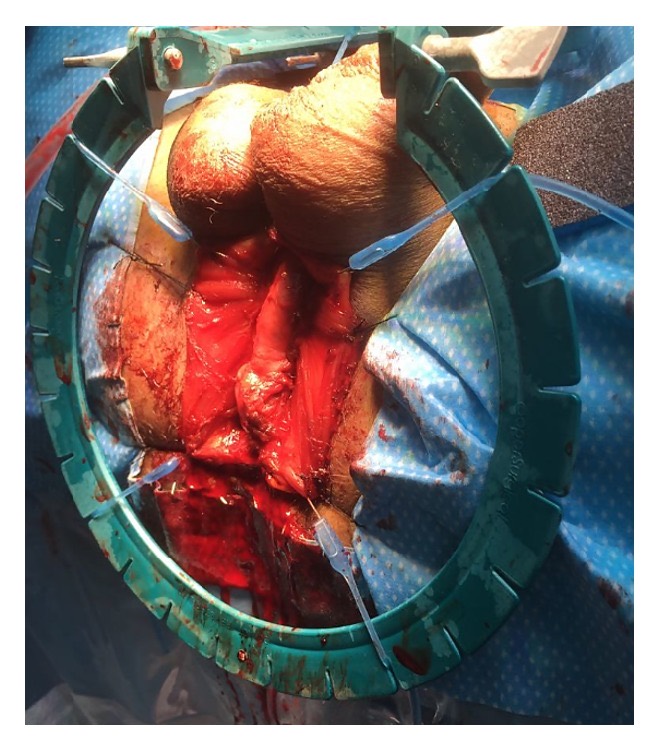
Perineal exposure of the bulbar urethra with four stay sutures and a Lone Star retractor, as in steps 1 to 4. The photograph comes from a urethroplasty review; for urethrectomy the spongiosum is then detached circumferentially from the corporal bodies. From Verla W, et al. Biomed Res Int. 2019;2019:9046430, Figure 4 (CC BY 4.0).[7]
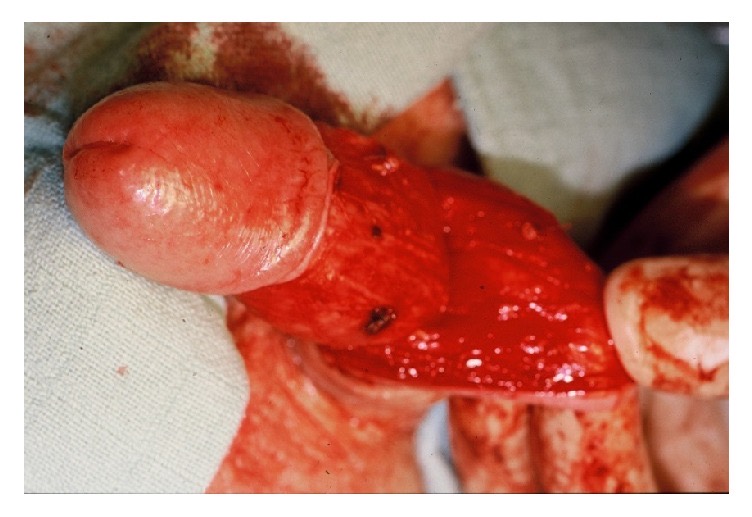
After a circumferential subcoronal incision, degloving along Buck's fascia exposes the entire penile urethra (step 5). From Verla W, et al. Biomed Res Int. 2019;2019:9046430, Figure 5 (CC BY 4.0).[7]
En Bloc Transpubic Approach
Partial pubectomy. DeTure described en bloc urethrectomy at cystectomy without a separate perineal incision and proposed lower perineal-wound contamination as a potential advantage.[8] DeTure described exposure comparable to the perineal route. Pubectomy and urethrectomy took about 30 min, which he reported as comparable to the time needed to expose and close a perineal incision.[8]
Phallus preservation for locally advanced proximal urethral carcinoma. March described complete perineal urethrectomy with proximal penectomy, en bloc pubectomy and excision of the pelvic diaphragm, leaving the remnant penis in place, in two patients with pT3 and pT4 proximal urethral cancer and no tumor invasion of the penile shaft. Both had an R0 resection, and there was no ischemic necrosis at 6 months. The remnant penis survives on the superficial penile arteries arising from the external pudendal arteries.[9]
Minimally Invasive
- Laparoscopic. 5-port transperitoneal cystoprostatectomy and lymphadenectomy with perineal urethrectomy and specimen extraction, described in two cases with a total operative time of 4.5–4.8 h.[10]
- Robot-assisted. In a 10-case series, side docking gave better perineal access than central docking and allowed simultaneous urethrectomy without undocking (performed in one case), without significant differences in operative time, transfusion, complications or hospital stay. A urethra-preserving robotic technique was reported to have no urethral recurrences (0/134) and favorable perioperative outcomes compared with robotic prophylactic urethrectomy, in a retrospective propensity-matched series.[11][12]
Surgical Approaches — Female
Historical anterior exenteration removed adjacent reproductive organs and vaginal wall with the bladder. The EAU guideline recommends sexual organ-preserving techniques in eligible women, selected by absence of tumor in the area to be preserved (strong); extent is determined by oncologic margins and the agreed diversion or reconstruction plan.[22][1][13] NCCN also recommends preserving the uterus, vagina or ovaries when feasible in appropriately selected patients (category 2A).[26] Practice differs by planned diversion: a woman going to an ileal conduit or other non-continent diversion routinely has the urethra removed at the same operation, while a woman being evaluated for orthotopic reconstruction is managed toward urethral preservation with a negative frozen-section margin, as above.
Key Anatomy
- The vaginal-wall smooth muscle contributes to urethral wall formation, particularly when the detrusor is poorly developed.[14]
- The middle urethra is tightly attached to vaginal smooth muscle with abundant veins at the interface, a major source of bleeding.[14]
- The rhabdosphincter fibers are concentrated in the middle and caudal thirds of the urethra; continence can be maintained if innervation remains intact when only the bladder neck and proximal urethra are removed.[15]
Technique
- Antegrade dissection from bladder neck distally allows direct vision. Hinata’s 965 mL mean blood loss was for 12 radical-cystectomy operations, not urethrectomy alone.[14]
- For primary female urethral carcinoma requiring radical urethrectomy, remove the urethra with all periurethral tissue from the bulbocavernosus muscles bilaterally and distally and a cylinder of adjacent soft tissue up to the pubic symphysis and bladder neck.[21] The vaginal wall is taken with the specimen when oncologically indicated.
- Reconstruction. When significant vaginal resection is required, a rectus abdominis myocutaneous flap vaginoplasty has been used to restore vaginal length and provide perineal-pelvic bulk, in a series of four patients.[16]
Distal Urethrectomy for Distal Lesions
For selected distal female urethral tumors, urethra-sparing distal resection may preserve an outlet if negative margins are established intraoperatively; EAU makes a weak recommendation for this approach.[21] Continence depends on resection extent and remaining sphincter function. In older partial-urethrectomy series, local recurrence was 22–60% at median follow-up of 153–175 months, and distal sleeve resection >2 cm was followed by secondary incontinence requiring reconstruction in 42%.[21] After urethra-sparing surgery for primary urethral carcinoma, EAU considers risk-tailored surveillance with urinary cytology, urethrocystoscopy and cross-sectional imaging prudent, while noting that follow-up has not been systematically studied.[30] See Distal Urethrectomy + Advancement Meatoplasty.
Oncologic Outcomes
Urethrectomy at Cystectomy — Risk-Stratified Benefit
- Multicenter (n = 887, Laukhtina 2022): urethrectomy at radical cystectomy was not associated with PFS, CSS or OS in the overall cohort. In the subgroup at high risk of urethral recurrence (n = 276; urethral invasion, bladder-neck invasion, multifocality or prostatic urethral involvement), urethrectomy was associated with a lower risk of progression (HR 0.58, p = 0.04).[17]
- Propensity-matched (Hakozaki 2021, 114 matched patients with incontinent diversion): 5-year OS did not differ overall. In the 58 patients with multiple tumors or concomitant CIS, prophylactic urethrectomy was associated with higher 5-year OS (p = 0.021), particularly in those not receiving neoadjuvant chemotherapy.[18]
- Single-center propensity-matched (n = 332, Mennes 2026): 10-year OS was higher in the prophylactic-urethrectomy group (47.3% versus 27.5%, p = 0.002). CSS and RFS did not differ significantly, and the 10-year urethral recurrence-free survival difference (98.2% versus 95.9%) was not significant after matching.[19]
In the Zennami series, urethra preservation in patients at high risk of urethral recurrence was associated with worse urethral recurrence-free, local recurrence-free and overall survival.[12] EAU states that prophylactic urethrectomy has not shown a survival benefit.[22] A retrospective study of 1,976 patients at 36 institutions found no statistically detectable IPTW-adjusted cancer-specific or overall survival difference within a 107-month analysis window; prophylactic urethrectomy was associated with estimated blood loss of 1,179 versus 983 mL and Clavien-Dindo grade 3 or higher postoperative complications of 14.6% versus 7.0%.[29] It advises follow-up of the male urethra in patients at risk, and urethrectomy for invasive urethral recurrence when the urethra is the only site of disease.[22] Recurrence risk depends on margins, urethral involvement and surveillance.[4][17][19]
Managing a Urethral Recurrence After Cystectomy
Following cystectomy with a retained urethra, NCCN advises considering urine cytology every 6–12 months for the first two years and thereafter as clinically indicated. Urethral wash cytology may be considered at the same intervals but is reserved for high-risk disease: a positive urethral margin, multifocal CIS or prostatic urethral invasion (category 2A).[26] A review reports higher-stage recurrence when detection follows symptoms rather than surveillance.[27]
Management of a confirmed urethral recurrence depends on the diversion already in place. With a non-orthotopic diversion, perineal urethrectomy can treat an isolated invasive urethral recurrence; distant disease requires systemic treatment planning.[22] With an orthotopic neobladder, preserving the urethra, and therefore the existing diversion, is preferred when feasible: intraurethral BCG perfusion has been described for CIS without a concomitant papillary tumor (5 of 6 patients with CIS remained recurrence-free after treatment in one series, while BCG failed in four patients with papillary or invasive disease), whereas a localized high-grade papillary or invasive (T1) recurrence is treated with urethrectomy and conversion to an alternative diversion. A locally advanced (T3/T4) urethral recurrence is staged and treated as a primary urethral tumor.[22] For locally advanced urothelial carcinoma, EAU weakly recommends following its MIBC guidance for perioperative systemic therapy; for locally advanced squamous cell carcinoma, it weakly recommends definitive chemoradiotherapy as an option for genital preservation.[21] Salvage urethrectomy has been described for selected recurrences, while systemic chemotherapy in the Varol series was given to two patients with metastatic disease.[27][28][27][28]
Primary Urethral Carcinoma (rare)
A 2026 meeting abstract described 35 patients with urethral SCC and heterogeneous multimodal treatment. Its five-year survival estimate, based on median 2.4-year follow-up, is not a urethrectomy-specific treatment result or a general prognosis for urethral cancer.[20]
Complications
Separate urethrectomy-specific morbidity from the entire cystectomy operation. Joniau reported ten local complications in 180 prepubic cases, including penile or scrotal hematomas. Elshal compared 71 prepubic with 115 perineal cysto-urethrectomies: its 9.5% versus 28% high-grade figures were 2/21 versus 7/25 reported complication events, not percentages of all operated patients.[6] Cross-study tables mixing these denominators are misleading.[4][6]
Vaginal dehiscence and bowel evisceration have been reported in a five-patient case series after anterior vaginectomy with urethrectomy at robotic cystectomy.[32]
Total and segmental resections have different functional consequences. Counsel according to the structures removed and reconstructed; urethrectomy is not assumed to spare continence or sexual function.[21]
Reconstructive Implications
- Total urethrectomy precludes an orthotopic neobladder anastomosed to the native urethra. A reconstructionist asked to perform or assist with the urethrectomy step should confirm the diversion plan first; once the urethra is out, the patient is committed to a conduit, continent cutaneous pouch or another suitable diversion.
- Urethral-margin assessment. AUA/ASCO/SUO 2024 Statement 14 (Clinical Principle) requires a negative urethral margin for orthotopic diversion; its discussion describes intraoperative margin assessment as best practice and says a preoperative positive prostatic urethral biopsy alone should not exclude a patient.[1] EAU 2026 (Strong) permits omission of frozen section in men with a negative prostatic urethral biopsy; after a positive biopsy, frozen section of the distal stump can determine whether malignancy is present at the dissection level.[22] See the guideline positions above. A systematic review and meta-analysis of 14 studies (8,208 patients across both urethral- and ureteral-margin analyses; five studies evaluated urethral margins) found pooled urethral-margin frozen-section sensitivity of 83% (95% CI 38–97%, reflecting substantial between-study heterogeneity) and specificity of 95% (95% CI 91–97%) for urethral margin involvement, with a pooled diagnostic odds ratio of 169.23 (95% CI 31.57–907.24) for a positive urethral-margin frozen section against final pathology.[1][22][25]
- Insufficient urethral length with a retained bladder. After urethrectomy without cystectomy, bladder-neck closure with a continent catheterizable channel or an incontinent stoma is an option when the remaining outlet cannot support continence; see Bladder Neck Closure.[21]
- Urethra-preserving robotic technique (Zennami 2024) has been used when oncologic criteria do not mandate urethrectomy and neobladder candidacy is being preserved.[12]
- Phallus preservation in proximal urethral carcinoma has been described in two patients; the external pudendal to superficial penile arterial supply is the basis of the technique.[9]
- Female surgery with a substantial vaginal defect may benefit from a rectus abdominis flap vaginoplasty or pelvic reconstruction, which is the reconstructive surgeon's contribution to the multidisciplinary cystectomy.[16]
See Also
- Urinary Diversion Principles
- Ileal Conduit
- Hautmann Neobladder
- Distal Urethrectomy + Advancement Meatoplasty (female distal lesion)
- Bowel Handling & Injury Management (rectal-injury pearl during cystoprostatectomy)
References
1. American Urological Association, ASCO and SUO. Treatment of Non-Metastatic Muscle-Invasive Bladder Cancer: guideline amended 2024. Official full guideline. Accessed September 12, 2026.
2. Ahlering TE, Lieskovsky G, Skinner DG. Indications for urethrectomy in men undergoing single-stage radical cystectomy for bladder cancer. J Urol. 1984;131(4):657–9. doi:10.1016/s0022-5347(17)50562-5
3. Zabbo A, Montie JE. Management of the urethra in men undergoing radical cystectomy for bladder cancer. J Urol. 1984;131(2):267–8. doi:10.1016/s0022-5347(17)50342-0
4. Joniau S, Shabana W, Verlinde B, Van Poppel H. Prepubic urethrectomy during radical cystoprostatectomy. Eur Urol. 2007;51(4):915–21. doi:10.1016/j.eururo.2006.09.046
5. Hiebl R, Langen PH, Haben B, Polsky MS, Steffens J. Prepubic urethrectomy with urethral stripping. J Urol. 1999;162(1):127–8. doi:10.1097/00005392-199907000-00029
6. Elshal AM, Barakat TS, Mosbah A, Abdel-Latif M, Abol-Enein H. Complications of radical cysto-urethrectomy using modified Clavien grading system: prepubic versus perineal urethrectomy. BJU Int. 2011;108(8):1297–300. doi:10.1111/j.1464-410X.2010.09987.x
7. Verla W, Oosterlinck W, Spinoit AF, Waterloos M. A comprehensive review emphasizing anatomy, etiology, diagnosis, and treatment of male urethral stricture disease. Biomed Res Int. 2019;2019:9046430. doi:10.1155/2019/9046430
8. DeTure FA. En bloc transpubic urethrectomy in conjunction with radical cystectomy for bladder carcinoma in males. Urology. 1977;10(6):553–5. doi:10.1016/0090-4295(77)90100-5
9. March B, Palma CA, Leslie S, et al. Phallus preservation for locally advanced proximal primary urethral carcinoma: technique and outcomes. Urology. 2023;173:198–203. doi:10.1016/j.urology.2022.12.034
10. Castillo OA, Pinto I, Portalier P, Díaz MA, Vitagliano G. Laparoscopic radical cystoprostatectomy and in-block urethrectomy in urethral cancer: initial experience in 2 cases. Surg Laparosc Endosc Percutan Tech. 2007;17(1):38–41. doi:10.1097/01.sle.0000213754.69137.2b
11. Chan ES, Yee CH, Chiu PK, et al. Robot-assisted radical cystectomy using a side-docking technique. J Laparoendosc Adv Surg Tech A. 2015;25(3):207–11. doi:10.1089/lap.2014.0417
12. Zennami K, Sumitomo M, Nukaya T, et al. Impact of urethra-preserving surgery during radical cystectomy: an optimal urethral management in the robotic era. Clin Genitourin Cancer. 2024;22(6):102146. doi:10.1016/j.clgc.2024.102146
13. Marshall FF, Treiger BF. Radical cystectomy (anterior exenteration) in the female patient. Urol Clin North Am. 1991;18(4):765–75. doi:10.1016/s0094-0143(21)00377-3
14. Hinata N, Murakami G, Abe S, et al. Detailed histological investigation of the female urethra: application to radical cystectomy. J Urol. 2012;187(2):451–6. doi:10.1016/j.juro.2011.10.037
15. Colleselli K, Stenzl A, Eder R, et al. The female urethral sphincter: a morphological and topographical study. J Urol. 1998;160(1):49–54. doi:10.1016/s0022-5347(01)63025-8
16. Parsons JK, Tufaro A, Chang B, Schoenberg MP. Rectus abdominis vaginoplasty after anterior exenteration for urologic malignancy. Urology. 2003;61(6):1249–52; discussion 1253. doi:10.1016/s0090-4295(03)00147-x
17. Laukhtina E, Boehm A, Peyronnet B, et al. Urethrectomy at the time of radical cystectomy for non-metastatic urothelial carcinoma of the bladder: a collaborative multicenter study. World J Urol. 2022;40(7):1689–1696. doi:10.1007/s00345-022-04025-z
18. Hakozaki K, Kikuchi E, Ogihara K, et al. Significance of prophylactic urethrectomy at the time of radical cystectomy for bladder cancer. Jpn J Clin Oncol. 2021;51(2):287–295. doi:10.1093/jjco/hyaa168
19. Mennes J, Akand M, Benijts R, et al. Prophylactic urethrectomy at the time of radical cystectomy for bladder cancer: does it really have an effect on oncological outcomes? BJU Int. 2026;137(3):555-565. doi:10.1111/bju.70096
20. Zahir M, Doshi C, Escobar D, et al. Primary urethral squamous cell carcinoma: insights and outcomes from a 27-year institutional experience. J Clin Oncol. 2026;44(Suppl 7):627. doi:10.1200/JCO.2026.44.7_suppl.627
21. EAU Guidelines on Primary Urethral Carcinoma: disease management. https://uroweb.org/guidelines/primary-urethral-carcinoma/chapter/disease-management. Accessed September 12, 2026.
22. European Association of Urology. EAU Guidelines on Muscle-invasive and Metastatic Bladder Cancer. March 2026 update. Sections 5.4 to 5.5 (urethral assessment), 6.7.2.b (women), 6.7.5.b and 6.7.5.d (patient selection) and 8.4 (urethral recurrence). Guideline.
23. Royal-Preyra B, Cury FL, Katib Y, et al. The rate of prostatic involvement in men treated with radical cystectomy for muscle invasive bladder cancer. Pract Radiat Oncol. 2023;13(1):e68-e72. doi:10.1016/j.prro.2022.06.001
24. García-Perdomo HA, Dávila-Raigoza AM, Summers E, et al. Urethral cancer: a comprehensive review endorsed by the Global Society of Rare Genitourinary Tumours. BJU Int. 2024;134(2):175-184. doi:10.1111/bju.16334
25. Laukhtina E, Rajwa P, Mori K, et al; EAU Young Academic Urologists Urothelial Carcinoma Working Group. Accuracy of frozen section analysis of urethral and ureteral margins during radical cystectomy for bladder cancer: a systematic review and diagnostic meta-analysis. Eur Urol Focus. 2022;8(3):752-760. doi:10.1016/j.euf.2021.05.010
26. National Comprehensive Cancer Network. NCCN Clinical Practice Guidelines in Oncology: Bladder Cancer. Version 3.2026. August 6, 2026. BL-B 2–3 of 4; BL-E 3–4 of 6; Discussion MS-18. Guideline.
27. Chan Y, Fisher P, Tilki D, Evans CP. Urethral recurrence after cystectomy: current preventative measures, diagnosis and management. BJU Int. 2016;117(4):563-569. doi:10.1111/bju.13370
28. Varol C, Thalmann GN, Burkhard FC, Studer UE. Treatment of urethral recurrence following radical cystectomy and ileal bladder substitution. J Urol. 2004;172(3):937-942. doi:10.1097/01.ju.0000135626.91587.c8
29. Miki J, Fukuokaya W, Taoka R, et al. "Oncological outcomes of prophylactic urethrectomy at the time of radical cystectomy for bladder cancer: A nationwide multi-institutional study." Int J Urol. 2024;31(9):1009-1016. doi:10.1111/iju.15505
30. European Association of Urology. "EAU Guidelines on Primary Urethral Carcinoma: Follow-up." 2026. Guideline.
31. Armenakas NA, Fracchia JA, Golan R. "Urethrectomy (Male)." In: Armenakas NA, Fracchia JA, Golan R, eds. Operative Dictations in Urologic Surgery. Wiley; 2019. doi:10.1002/9781119524328.ch67
32. Lin FC, Medendorp A, Van Kuiken M, Mills SA, Tarnay CM. "Vaginal dehiscence and evisceration after robotic-assisted radical cystectomy: a case series and review of the literature." Urology. 2019;134:90-96. doi:10.1016/j.urology.2019.09.009