Mainz Pouch III
The Mainz pouch III (colon pouch) is a continent cutaneous urinary reservoir built only from colon, using transverse colon with either the ascending or the descending colon, and emptied by intermittent catheterization through an umbilical stoma. Leissner, Fisch, Hohenfellner and colleagues reported it in 2000 for women who had received pelvic irradiation. Because irradiated bowel is associated with more early and late complications, the reservoir and efferent segment are made only from nonirradiated bowel.[1][2]
Pelvic irradiation commonly also affects the small bowel, the rectosigmoid and the ureter, the tissues on which the ileocecal Mainz pouch I and the rectosigmoid Mainz pouch II depend.[3] The evidence for the colon pouch consists of retrospective single-center series and technical reports, the largest with 44 patients, and no study compares it directly with another diversion. For the incontinent counterpart built from the same bowel, see Colon Conduit; for selection across diversion types, see Principles of Urinary Diversion.
Historical Development
- 1975 and 1976. Schmidt and colleagues proposed the transverse colon conduit after pelvic radiotherapy because it provides a short segment of nonirradiated bowel and allows the ureters to be dissected well above the radiation field. They reported 8 patients with bladder or cervical carcinoma treated with high-dose external radiotherapy, then 22 patients with an operative mortality of 4%.[4][5]
- 1982. Beckley reported satisfactory results in the last 30 patients of a transverse colon conduit series after pelvic irradiation, using an end-to-end refluxing (Wallace) ureterocolic anastomosis that permits later retrograde conduitography.[6]
- 1991. Fisch, Riedmiller and Hohenfellner described pyelotransverse pyelocolostomy, a transverse colon conduit joined directly to both renal pelves or ureteropelvic junctions, in 7 patients whose middle and distal ureters could not be used after radiation or multiple operations.[7]
- 2000. Leissner reported the Mainz colon pouch in 44 irradiated women.[1] Ferreira reported a continent, nonrefluxing transverse colonic reservoir (the Unicamp technique) in 20 irradiated patients.[8]
- 2002. Wammack compared the ileocecal Mainz pouch I in 36 irradiated and 385 nonirradiated patients and concluded that it should be avoided after pelvic radiotherapy.[9] Kato described continent transverse colon pouches in 3 women treated with radiotherapy for cervical cancer.[10]
- 2006 and 2007. Leissner, Fisch and Hohenfellner published a surgical-atlas description of the colonic pouch.[2] Stolzenburg reported 24 patients, 6 of whom had not received radiotherapy, and proposed extending the indication.[11] Bissada described a variant made purely from transverse colon.[12]
Indications and Selection
Published indications are mainly in women after radiotherapy for gynecologic cancer:
- Irreparable radiation fistula. Irreparable vesical fistula accounted for 20 of 44 patients in the Mainz series, and vesicovaginal fistula after definitive radiotherapy for gynecologic tumors for 14 of 20 in the Unicamp series.[1][8]
- Exenteration for recurrent or advanced pelvic cancer. Local recurrence of a gynecologic tumor accounted for 22 of the 44 Mainz patients, and 16 of Stolzenburg's 24 patients had hysterectomy and pelvic exenteration for gynecologic tumors.[1][11]
- Cystectomy after pelvic radiotherapy. Two Mainz patients had radical cystectomy for bladder cancer, and 6 Unicamp patients had received radiotherapy as definitive treatment for invasive bladder cancer.[1][8]
- Patients without radiotherapy. Stolzenburg's series included 6 patients without previous radiotherapy. Its indications also included prostatic rhabdomyosarcoma in 2 men, rectal resection for infiltrating rectal cancer, combined nephrectomy and cystectomy, and benign hyper-reflexive or neurogenic bladder dysfunction.[11] A case report describes a colon pouch built because the appendix was too short for a Mainz pouch I, later used as the reservoir for a kidney transplant.[13]
A 2006 review reported treatment-related severe morbidity exceeding 50% after pelvic exenteration for gynecologic tumors and suggested compromised healing of irradiated tissue and complex reconstruction as possible contributors.[14]
The general requirements for a continent cutaneous reservoir (suitable bowel, renal and hepatic reserve, and the ability to catheterize reliably) are covered in Principles of Urinary Diversion. In the irradiated patient, a German review names three factors for choosing the diversion: the length of functional ureter, the position of bowel outside the irradiated area, and the type of diversion. It describes an ascending-transverse or transverse-descending colon pouch with the efferent segment brought out through the umbilicus as the preferred continent option.[3] Other German reviews recommend nonirradiated segments such as transverse colon after preoperative radiotherapy, placement of the diversion outside the field when postoperative radiotherapy is planned, and training or referral to a specialized center, given limited contemporary experience with large-bowel surgery among urologists.[15][16] These are expert reviews, not graded guideline recommendations.
Rationale: Irradiated Bowel and Ureter
Wammack's retrospective comparison of the ileocecal Mainz pouch I (median follow-up 57 months) found a significantly higher rate of serious complications in irradiated patients. The control group had cystectomy for bladder cancer without radiotherapy.[9]
| Outcome | Irradiated (n = 36) | Nonirradiated (n = 385) |
|---|---|---|
| Continence-mechanism failure | 25% | 5.7% |
| Stomal complications | 38.8% | 10.6% |
| Ureteral complications | 22.2% | 6.5% |
The distal ureter is also exposed. The transverse colon lies in the upper abdomen, close enough to the kidneys for a high anastomosis, and Fisch described it as mostly spared from irradiation.[7] Schmidt's rationale was the same: nonirradiated bowel and a ureter divided well above the field.[4][5] Whether a particular segment is outside the field depends on the treatment volume and the intraoperative findings. Leissner chose between the ascending and descending colon according to the length of nonirradiated bowel available.[1] See Radiation and Tissue Effects and Reoperative Bowel Harvest for assessment of irradiated bowel and mesentery.
Operative Design
The originators' stepwise description is the 2006 surgical atlas.[2] The outline below is drawn from the published series and technical reports; segment lengths vary with the patient and the extent of nonirradiated colon.
- Choose the segment by the extent of nonirradiated colon. Leissner used a transverse-descending colon pouch in 36 and a transverse-ascending colon pouch in 8 of 44 patients. Kato isolated approximately 30 cm of transverse colon, and the transplant case report used approximately 35 cm of ascending and transverse colon.[1][10][13]
- Open and reconfigure the bowel. Antimesenteric opening and spherical reconfiguration produce the high-volume, low-pressure reservoir common to continent cutaneous pouches.[17]
- Build the efferent segment within the pouch wall. In the Mainz technique, a tapered bowel segment is embedded in the pouch wall and brought to an umbilical stoma.[1] This applies the principle of incorporating the efferent segment into the reservoir wall, shared with the appendix stoma and the serosa-lined extramural tunnel.[17] Kato used a reconfigured colon segment as the continence valve in 2 patients and the appendix in 1.[10]
- Implant the ureters above the field. Leissner used a submucosal tunnel in 67 renal units and a subserosal extramural tunnel in 17. The Unicamp reservoir is nonrefluxing; Kato implanted both ureters submucosally in 2 patients and used reconfigured colon to reconstruct a ureteral defect in 1.[1][8][10] When the ureters are unusable over most of their length, anastomosis of transverse colon to the renal pelves has been described in conduit form.[7]
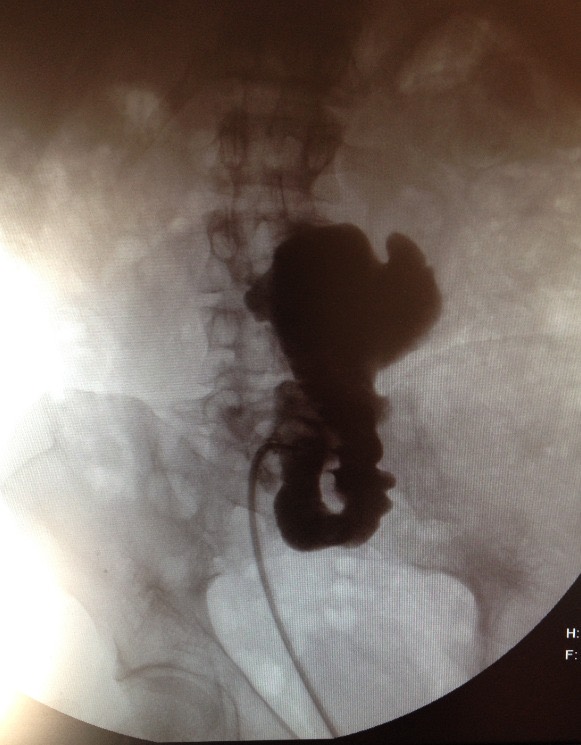
Pouchogram of a Mainz pouch III built from about 35 cm of ascending and transverse colon as the first stage before kidney transplantation; the native right ureter was implanted with an antireflux technique, and pouch capacity exceeded 200 mL. From Markić D, et al. Croat Med J. 2019;60(6):545-551, Figure 1 (CC BY-NC).[13]
The outlet principles overlap with the appendix and bowel-flap outlets of the Mainz pouch I; broader outlet planning is covered in Catheterizable Channels.
Variants
- Unicamp transverse colonic reservoir. A heterotopic continent reservoir of transverse colon with a catheterizable conduit and nonrefluxing ureteral implantation, described by the Campinas group.[8][18]
- Pure transverse colon reservoir (Bissada). Two short transverse colon segments are fashioned as Monti tubes and placed in a serous-lined extramural tunnel, one forming the efferent segment and the other used for ureteral reimplantation. The report is a technical description.[12]
Outcomes
| Series | Patients and follow-up | Continence and emptying | Upper tracts and complications |
|---|---|---|---|
| Leissner 2000[1] | 44 women after pelvic irradiation; mean 52.2 months | Incontinence in 2, both continent after reoperation | No pouch-related complications in the immediate postoperative period; upper-tract dilation in 5 renal units, all dilated before surgery, none reimplanted; umbilical stoma stenosis in 6 (13.6%) |
| Stolzenburg 2007[11] | 24 patients, 18 irradiated (32–48 Gy); mean 35 months (12–65) | 20 fully continent; 4 with capacity <300 mL slightly incontinent and wearing a pad at the umbilicus; catheterization mean 6.8 per day (6–12) | Mean capacity 293.8 mL; 1 outlet stenosis revised; asymptomatic reflux on pouchogram in 4; no metabolic acidosis or diarrhea; 3 deaths (2 disease progression, 1 suicide) |
| Ferreira 2000 (Unicamp)[8] | 20 irradiated patients; median 4.5 years (1–8) | Intermittent self-catheterization every 3–4 hours | Median capacity 450 mL (350–600), with no contractions or contractions <35 cm H₂O; hydronephrosis (mild in 10 before surgery) improved in 4, none deteriorated; reflux on 1 pouchogram; moderate untreated metabolic acidosis in 12; persistent asymptomatic bacteriuria in 14, no clinical infections reported |
| Kato 2002[10] | 3 women after radiotherapy for cervical cancer | All catheterized easily without incontinence | No complications reported |
A later case report summarizing the Mainz series states that four stomal stenoses were treated by endoscopic incision and two by Y-V plasty, and that both incontinent patients received a new efferent segment.[1][13] These amount to 8 reported outlet or stoma procedures among the 44 patients.
The series use different continence definitions and do not grade complications. Stolzenburg reported no metabolic acidosis, whereas Ferreira found moderate untreated acidosis in 12 of 20; the abstracts do not define acidosis or the monitoring schedule.[11][8] Stolzenburg's authors include Fisch and Hohenfellner, and the reports do not state whether patients overlap with the 2000 Mainz series.
Complications and Follow-Up
- Stoma and outlet. Stomal stenosis was the most frequent problem in the Mainz series (6 of 44); Stolzenburg recorded one outlet stenosis needing revision.[1][11]
- Continence. All 4 slightly incontinent patients in Stolzenburg's series had a pouch capacity below 300 mL.[11]
- Upper tracts. Leissner's 5 dilated renal units had all been dilated before surgery, Ferreira reported no upper-tract deterioration, and reflux on pouchography was asymptomatic in Stolzenburg's series.[1][11][8]
- Metabolic and infectious. Moderate acidosis and asymptomatic bacteriuria were frequent in the Unicamp series.[8] Surveillance follows the shared protocol for urine-exposed bowel; see Renal Function and Metabolic Surveillance, Urinary Acidifiers and Alkalinizers and Mucus Management.
- Secondary neoplasia. None of the Mainz pouch III series reports reservoir neoplasia or an endoscopic surveillance protocol, and their follow-up (mean or median 35 to 54 months, range up to 8 years) is short for this endpoint.[1][11][8] Data for ileocecal reservoirs are summarized on the Mainz pouch I page.
Comparison With Alternatives
No study compares the colon pouch directly with an ileocecal reservoir, a colon conduit or an ileal conduit in irradiated patients. Indirect data on other reservoirs after radiotherapy are mixed:
- Ileocecal Mainz pouch I. Continence-mechanism, stomal and ureteral complications were 3.4 to 4.4 times more frequent in irradiated patients (table above).[9]
- Florida pouch. In Webster's long-term cohort (74 patients analyzed, mean follow-up 133 months), ureteral obstruction occurred in 4 of 14 irradiated ureters (reported as 28.4%) and in 7 of 108 primary reimplantations (6.3%), p = 0.02.[19]
- Indiana pouch. Wilkin compared 12 women with recurrent gynecologic cancer after high-dose radiation (mean 78.1 Gy) with 14 nonirradiated women. Percutaneous nephrostomy (6 versus 1) and ureteral reimplantation (4 versus 0) were more frequent after radiation (both p = 0.03); the overall complication and reoperation differences were not significant.[20]
- Right colon pouch. Myers found no association between radiation injury (17 of 53 patients) and complications, readmission or reoperation after right colon pouch diversion, and noted that the cohort may have lacked power to detect one. The cumulative reoperation rate in the whole cohort was 53%.[21]
When continence is not pursued, the colon conduit uses the same nonirradiated bowel. In Hebert's multi-institutional retrospective study of 179 colon conduits (prior radiation in 63.7%), 30-day high-grade complications occurred in 28.5% and 90-day mortality was 4.5%; preoperative albumin ≥3.2 g/dL was associated with fewer 30–90-day high-grade complications (HR 0.18). The authors concluded that colon remains an option when ileum is not clinically feasible.[22]
Removing colon has bowel consequences. In a single-center prospective study of 38 patients undergoing diversion for radiation injury (82% after prostate radiation), colon conduits and right colon pouches were associated with worse bowel-related quality of life and more fecal incontinence episodes than ileal conduits.[23] The Mainz pouch III was not studied separately.
Evidence Gaps
- The largest series has 44 patients; all are retrospective and single center, and none has a comparison group.
- Mean or median follow-up is 35 to 54 months, so long-term stone, renal, metabolic and neoplasia outcomes are not documented.
- Definitions of continence, acidosis and complications vary, and complications are not graded by a standard system.
- Most patients are women after gynecologic radiotherapy; outcomes after prostate radiotherapy are not reported separately.
- Bowel function after removal of transverse and descending or ascending colon has not been measured in Mainz pouch III patients.
See Also
- Mainz Pouch I
- Mainz Pouch II (Sigma-Rectum Pouch)
- Colon Conduit
- Florida Pouch
- Indiana Pouch
- Vesicovaginal Fistula
- Radiation and Hemorrhagic Cystitis
References
1. Leissner J, Black P, Fisch M, Höckel M, Hohenfellner R. "Colon Pouch (Mainz Pouch III) for Continent Urinary Diversion After Pelvic Irradiation." Urology. 2000;56(5):798–802. doi:10.1016/s0090-4295(00)00789-5
2. Leissner J, Fisch M, Hohenfellner R. "Colonic Pouch (Mainz-Pouch III) for Continent Urinary Diversion." BJU Int. 2006;97(2):417–30. doi:10.1111/j.1464-410X.2006.06052.x
3. Pycha A, Trenti E. "High Urinary Diversion After Irradiation to the Lesser Pelvis" (in German). Urologe A. 2020;59(4):416–25. doi:10.1007/s00120-020-01156-2
4. Schmidt JD, Hawtrey CE, Buchsbaum HJ. "Transverse Colon Conduit: A Preferred Method of Urinary Diversion for Radiation-Treated Pelvic Malignancies." J Urol. 1975;113(3):308–13. doi:10.1016/s0022-5347(17)59469-0
5. Schmidt JD, Buchsbaum HJ, Jacobo EC. "Transverse Colon Conduit for Supravesical Urinary Tract Diversion." Urology. 1976;8(6):542–6. doi:10.1016/0090-4295(76)90514-8
6. Beckley S, Wajsman Z, Pontes JE, Murphy G. "Transverse Colon Conduit: A Method of Urinary Diversion After Pelvic Irradiation." J Urol. 1982;128(3):464–8. doi:10.1016/s0022-5347(17)52999-7
7. Fisch M, Riedmiller H, Hohenfellner R. "Pyelotransverse Pyelocolostomy: An Alternative Method for High Urinary Diversion in Patients With Extended Bilateral Ureter Damage." Eur Urol. 1991;19(2):142–9. doi:10.1159/000473603
8. Ferreira U, Rodrigues Netto N Jr, Lucena R. "The Transverse Colonic Reservoir: The Unicamp Technique." BJU Int. 2000;85(4):486–9. doi:10.1046/j.1464-410x.2000.00522.x
9. Wammack R, Wricke C, Hohenfellner R. "Long-Term Results of Ileocecal Continent Urinary Diversion in Patients Treated With and Without Previous Pelvic Irradiation." J Urol. 2002;167(5):2058–62. doi:10.1016/s0022-5347(05)65083-5
10. Kato H, Igawa Y, Komiyama I, Nishizawa O. "Continent Urinary Reservoir Formation With Transverse Colon for Patients With Pelvic Irradiation." Int J Urol. 2002;9(4):200–3. doi:10.1046/j.1442-2042.2002.00448.x
11. Stolzenburg JU, Schwalenberg T, Liatsikos EN, et al. "Colon Pouch (Mainz III) for Continent Urinary Diversion." BJU Int. 2007;99(6):1473–7. doi:10.1111/j.1464-410X.2007.06767.x
12. Bissada NK, Abdallah MA. "Technique for Pure Transverse Colon Continent Cutaneous Urinary Diversion." Urology. 2007;69(1):173–4. doi:10.1016/j.urology.2006.10.038
13. Markić D, Oguić R, Krpina K, et al. "Kidney Transplantation Using a Colon Pouch (Mainz Pouch III): A Case Report." Croat Med J. 2019;60(6):545–51. doi:10.3325/cmj.2019.60.545. Full text.
14. Höckel M, Dornhöfer N. "Pelvic Exenteration for Gynaecological Tumours: Achievements and Unanswered Questions." Lancet Oncol. 2006;7(10):837–47. doi:10.1016/S1470-2045(06)70903-2
15. Stein R, Kamal MG, Rubenwolf P, Großmann A, Thomas C, Thüroff JW. "Continent Urinary Diversion Following Anterior Exenteration" (in German). Urologe A. 2015;54(3):359–67. doi:10.1007/s00120-014-3684-0
16. Ahyai SA, Sayedahmed K, Engel O, Chun F, Dahlem R, Fisch M. "Urinary Diversion and Colon: Transverse Conduit and Transverse Pouch" (in German). Urologe A. 2012;51(7):937–46. doi:10.1007/s00120-012-2907-5
17. Fisch M, Thüroff JW. "Continent Cutaneous Diversion." BJU Int. 2008;102(9 Pt B):1314–9. doi:10.1111/j.1464-410X.2008.07976.x
18. D'Ancona CA, Cavaller AR, Ferreira U, et al. "Continent Urinary Diversion in Patients With Pelvic Irradiation: An Alternative Utilizing Transverse Colon Reservoir." Int Urol Nephrol. 2005;37(3):499–500. doi:10.1007/s11255-004-4708-2
19. Webster C, Bukkapatnam R, Seigne JD, et al. "Continent Colonic Urinary Reservoir (Florida Pouch): Long-Term Surgical Complications (Greater Than 11 Years)." J Urol. 2003;169(1):174–6. doi:10.1016/S0022-5347(05)64061-X
20. Wilkin M, Horwitz G, Seetharam A, et al. "Long-Term Complications Associated With the Indiana Pouch Urinary Diversion in Patients With Recurrent Gynecologic Cancers After High-Dose Radiation." Urol Oncol. 2005;23(1):12–5. doi:10.1016/j.urolonc.2004.07.018
21. Myers JB, Martin C, Cheng PJ, Zhang C, Presson AP. "Outcomes of Right Colon Continent Urinary Pouch Using Standardized Reporting Methods." Neurourol Urodyn. 2019;38(5):1290–7. doi:10.1002/nau.23951
22. Hebert KJ, Swinney S, Johnson R, et al. "Outcomes After Colon Conduit Urinary Diversion: A Multi-Institutional Retrospective Study From the Reconstruction and Diversion: Improving Outcomes Group." J Urol. 2026;215(5):621–32. doi:10.1097/JU.0000000000004935
23. Schlaepfer CH, Kurtzman JT, Ramsay J, Myers JB. "Patient-Reported Bowel-Related Quality of Life After Urinary Diversion for Radiation Injury: A Single-Center Prospective Study." Urology. Published online August 6, 2026. doi:10.1016/j.urology.2026.07.046